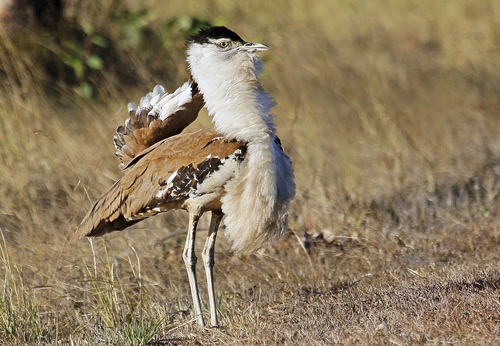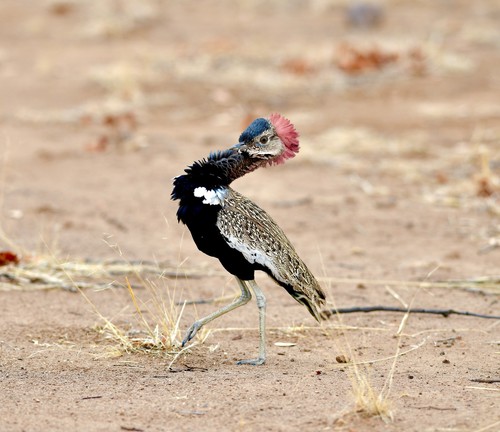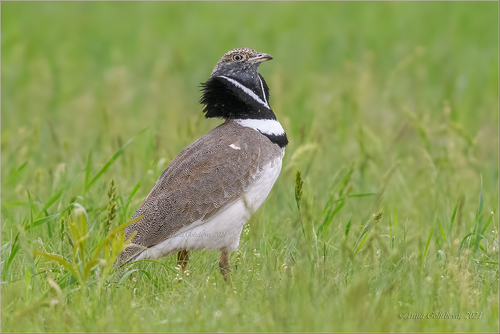
About Tetrax tetrax (Linnaeus, 1758)
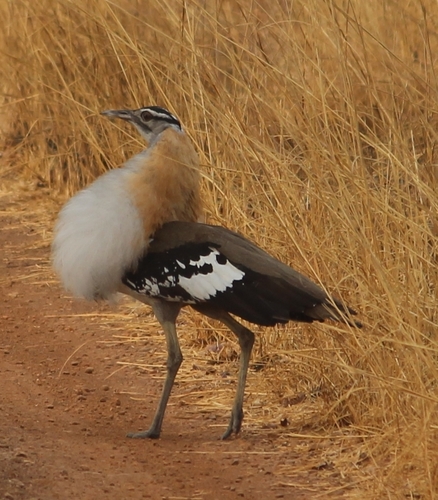
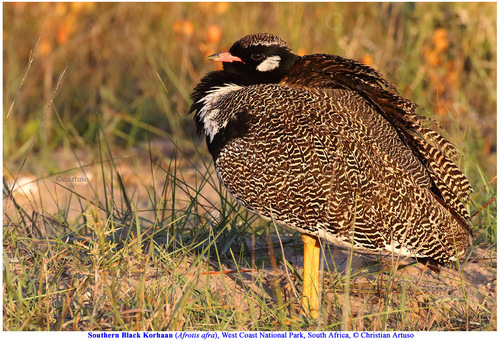
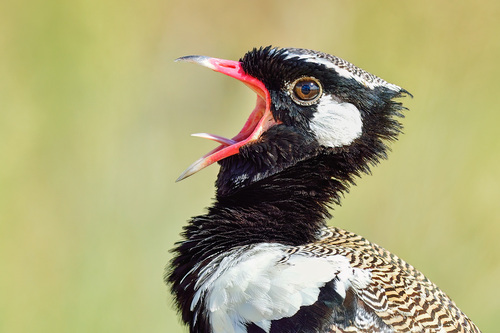
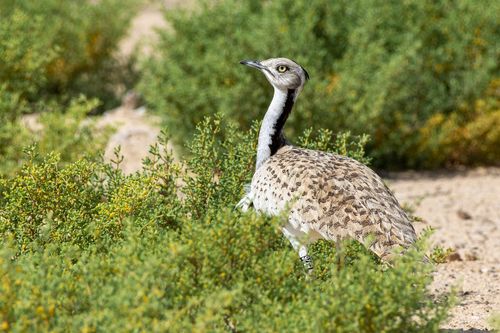
Although it is the smallest bustard found in the Palearctic, the little bustard is still comparable in size to a pheasant. It measures 42–45 cm (17–18 in) in length, has a wingspan of 90–110 cm (35–43 in), and weighs around 830 g (29 oz). In flight, the long wings show extensive white coloring. Breeding males are brown on their upper body and white on their underbody, with a grey head and a black neck bordered both above and below by white. Females and non-breeding males do not have this distinct neck pattern, and females have darker markings on their underbody than males. Immature little bustards resemble adult females. Both sexes are usually silent, but males produce a distinctive "raspberry-blowing" call transcribed as prrt.
This species breeds in Southern Europe, and Western and Central Asia. Most southernmost European populations are resident, while other populations migrate further south for the winter. The central European population that once bred in the grasslands of Hungary went extinct several decades ago. Across its entire range, the species is declining due to habitat loss. It previously bred across a much wider area, for example it occasionally ranged as far north as Poland. Even though it breeds in France, it is only a very rare vagrant to Great Britain. On 20 December 2013, Cypriot newspapers Fileleftheros and Politis, along with news website SigmaLive, reported the discovery of a dead little bustard in the United Nations Buffer Zone. The bird had been shot by poachers hunting illegally in the zone. The shooting was particularly controversial among conservationists and birdwatchers, because the little bustard is a very rare visitor to Cyprus and had not been officially recorded on the island since December 1979.
The little bustard inhabits open grassland and undisturbed cultivation, with plants tall enough to provide cover. Males and females do not differ significantly in their habitat selection. It has a deliberate, stately walking gait, and tends to run rather than fly when disturbed. It is a gregarious species, especially during the winter. Tracking studies of male little bustards have shown that they are nocturnal migrants that make frequent stopovers in both non-irrigated and irrigated croplands, to reach more productive agricultural post-breeding areas. The little bustard is omnivorous, and feeds on seeds, insects, rodents, and reptiles.