About Tetratheca thymifolia Sm.
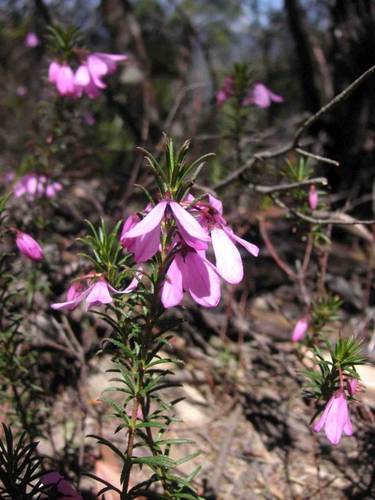
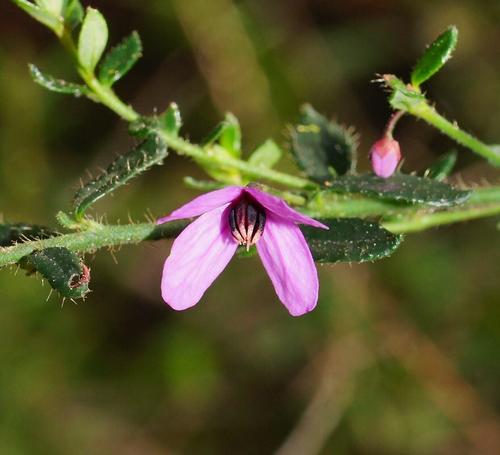
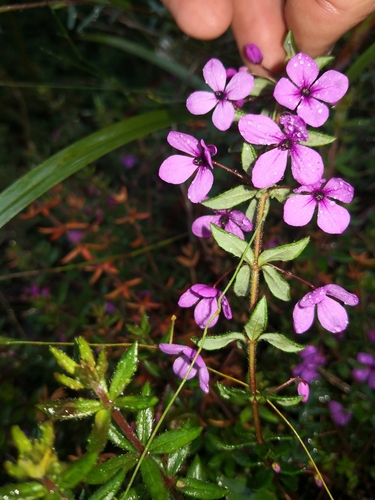
Tetratheca thymifolia, commonly called black-eyed Susan or thyme pink-bells, is a small shrub in the family Elaeocarpaceae native to southeastern Australia. It was first formally described by English botanist James Edward Smith in 1804. Its specific epithet is derived from the Latin words folium, meaning 'leaf', and thymus, referring to its similarity to thyme plants. The genus name comes from the Ancient Greek words tetra meaning 'four' and theke meaning 'sac or box', a reference to the species' four-celled anthers. This plant grows as a tough-stemmed shrub reaching up to 1 metre (3 feet) in height. Its main flowering period runs from September to November, though individual flowers may appear at any time of year. The flowers are 2.5 centimetres (1 inch) across, and produce a strong fragrance on hot days. It is distributed across southeastern Queensland, through New South Wales, and into East Gippsland in eastern Victoria, where it grows in heathland or eucalyptus woodland on sandy soils. It was first introduced to horticulture in England in 1824, and has been cultivated to some degree ever since. Several cultivated forms have been selected for horticultural use, including the cultivar T. 'Bicentennial Belle', which was collected from a naturally occurring population near Bega, New South Wales. This cultivar grows to 0.7 m tall and up to 0.9 m wide, and spreads freely via suckers. It was registered with the Australian Cultivar Registration Authority in 1985 by Austraflora Nursery in Montrose, Victoria. 'Bicentennial Belle' flowers year-round, with peak flowering in spring and autumn, and produces larger flowers than the wild species. In cultivation, Tetratheca thymifolia grows best in well-drained acidic soil, in a full sun or semi-shaded position, and tolerates light frosts. It is commonly grown in container gardens or rockeries.