About Tetratheca pilosa Labill.
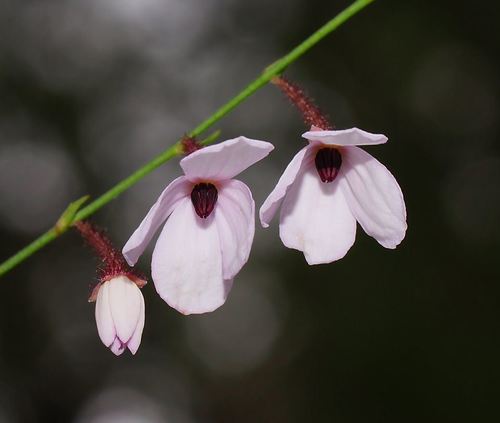
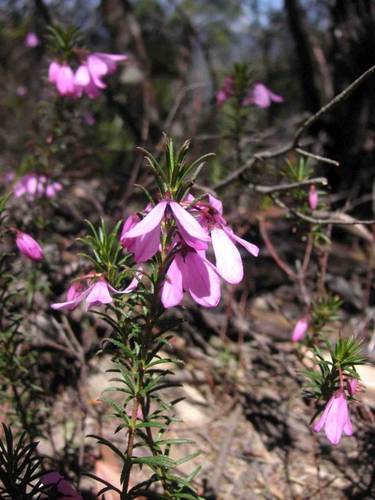
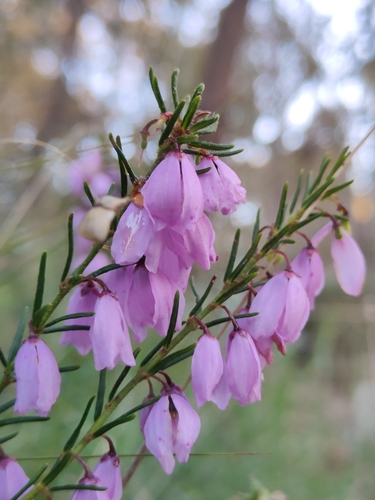
Tetratheca pilosa Labill. is characterized by pink to mauve, drooping (pendulous), axillary, solitary radially symmetrical flowers. These flowers measure 6 mm long and have 4 sepals, 4 petals, and usually 8 stamens that open through an apical pore. The stamens form a dark center above a superior ovary; the stamen tube is widest between its base and apex and is often hidden by the petals, which gives the species its common name black eyed susan. Stems are erect, and are either unbranched or branched from the base. Leaves are green, narrow, distinctly arranged alternately, and are slightly revolute or have recurved margins. Leaves can be hairless or covered with non-glandular hairs, and reach up to 15 mm in length. The fruit of Tetratheca pilosa has locules that split open as the fruit dries out, releasing between 1 and 5 seeds. Tetratheca pilosa is one of only a few Tetratheca species that occurs across multiple Australian states, as most other species in the genus are locally endemic. It can be found in Tasmania, Victoria, the southeastern corner of South Australia, and in a small number of localized patches in New South Wales. This species grows in open woodland, heathland, and dry sclerophyll forests. The vegetation where it occurs generally has a sparse understorey and an open Eucalyptus canopy. Dominant canopy tree species depend on the local substrate, and may include Eucalyptus amygdalina, Eucalyptus delegatensis, or Eucalyptus obliqua. A sparse understorey containing Banksia marginata and Exocarpus cupressiformis is common. Tetratheca pilosa grows sparsely among other woody shrub species such as Epacris impressa, Pultenaea juniperina, and Daviesia latifolia. The ground cover is usually made up of a sparse layer of Gonocarpus teucroides, plus a high coverage of fine litter and rocks. Tetratheca pilosa performs poorly when competing with other plants, but has a strong competitive advantage in sandy, gravelly, hydrophobic, acidic, and nutrient-poor soils. It persists on substrates derived from sandstone, Permian mudstone, siltstone, and granite. The black center of its flowers acts as a target for native bees, which are capable of performing buzz pollination. For buzz pollination, bees use their flight muscles to vibrate pollen loose, a skill that European bees do not have. Only 9% of the world's plant species use this form of pollination. Tetratheca seeds are a food source for ants, which collect, disperse, and carry the seeds underground. This process provides multiple advantages for the plant: it creates a soil seed store that is protected from fire, and disperses seeds further than wind could carry them.