About Tetratheca juncea Sm.
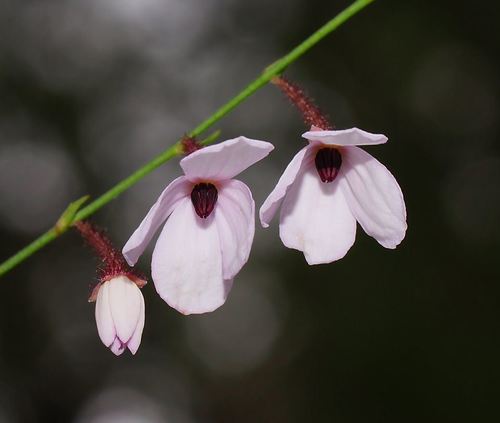
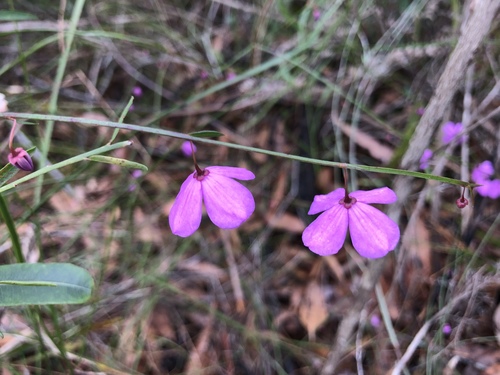
Tetratheca juncea Sm. is a sprawling plant with mostly leafless stems that grow between 30 and 60 centimeters long. Its stems typically have 2 to 3 narrow wings, a feature that sets this species apart from other Tetratheca species. It produces four-petalled flowers that face downward, and these flowers can range in colour from white to pink to dark purple. Tetratheca juncea can reproduce either by spreading underground stems that extend up to 50 centimeters, or through sexual reproduction, which requires insect pollination. This species occurs mostly in the grassy groundcover of low open forest or woodland with a mixed shrub understorey. It prefers cooler southerly aspects and well-drained soils, so it is often found growing on ridges. Tetratheca juncea is considered vulnerable because it is restricted to a small area covering the northern part of the Sydney Basin bioregion and the southern part of the North Coast bioregion. Within this limited range, the species is quite abundant. Larger populations are viewed as particularly important for the conservation of this species.