About Tetratheca glandulosa Sm.
Glandular pink-bell, scientifically named Tetratheca glandulosa Sm., is a small, spreading shrub that reaches 20–50 cm (7.9–19.7 in) in height. It has a woody, tuberous root, and stems branch out from close to the base of the plant. The stems often grow entwined among nearby surrounding plants, including other shrubs, grasses, and sedges.
Its leaves can be arranged alternately, oppositely, or very rarely in whorls of three or four. They are linear in shape, measuring 3–20 mm long and 1–2 mm wide, with margins that are recurved, or rolled under. The leaves have stiff, occasionally gland-tipped hairs that create a "toothed" appearance. The midrib on the lower surface of the leaf is often glandular or hairy, and the leaves are sometimes sessile, meaning they grow without a petiole or leaf stem.
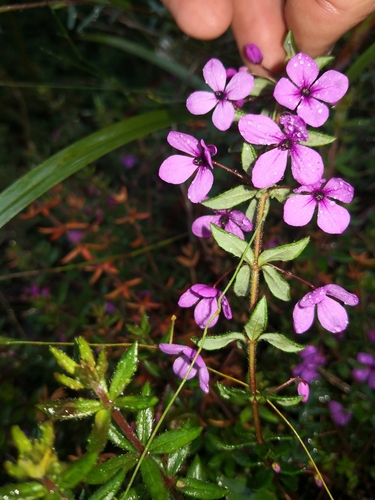
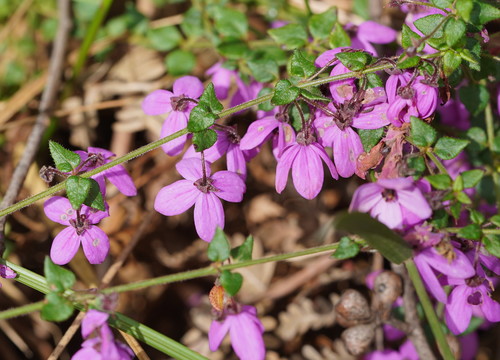
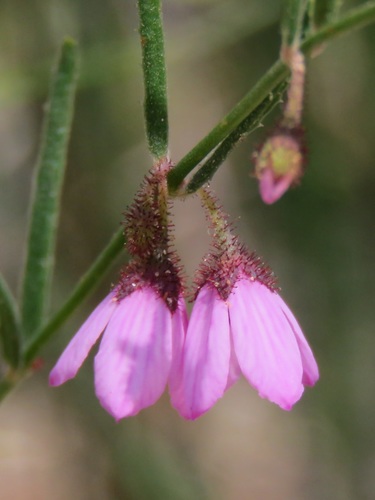
Flowers of this species are mostly solitary, and only rarely paired, growing on stalks 3–10 mm long. The stalks are covered with dark red, gland-tipped, tubercle-based hairs, a trait that distinguishes this species from other members of the genus Tetratheca. The sepals are 2–3 mm long and remain attached to the plant as the fruit develops. The deep lilac-pink petals are 4.5–10.5 mm long, and also persist on the fruit. The ovary is hairy and contains two ovules. The mature fruit is 3–7 mm long, and the seeds measure more than 3 mm in length. Flowering occurs mostly from July to November, though flowers may still be present as late as December.
This species is found in the Central Coast and Sydney Basin bioregions of New South Wales, Australia. It occurs within the local government areas of The Hills Shire, Gosford, Hawkesbury, Hornsby, Ku-ring-gai, Northern Beaches, Ryde, and Wyong. Around 150 to 200 subpopulations are currently known; the northernmost limit of its range is Yengo National Park, and the southernmost is Lane Cove National Park. It extends as far east as Ingleside and as far inland as Wollemi National Park. Historical collections confirm the species once grew further south in areas including Manly and Mosman, but these populations are now considered locally extinct.
Glandular pink-bell grows in a range of habitats and soil types, but it is most commonly found in shallow, clayey-loam soils in the shale-sandstone transition zone on Hawkesbury sandstone. It grows on ridgetops and upper slopes in heath, scrub, open woodland, and open forest. The largest populations grow in woodland ecological communities that provide a semi-shaded environment. Common associated woodland tree species include eucalypts: red bloodwood (Corymbia gummifera), yellow bloodwood (Corymbia eximia), scribbly gum (Eucalyptus haemastoma), grey gum (Eucalyptus punctata), snappy gum (Eucalyptus racemosa), and narrow-leaved stringybark (Eucalyptus sparsifolia). Its understorey associates are shrubs from the Proteaceae, Fabaceae, and Epacridaceae families. It can also grow alongside Darwinia biflora, another threatened species, usually as part of the Shale/Sandstone Transition Forest community.