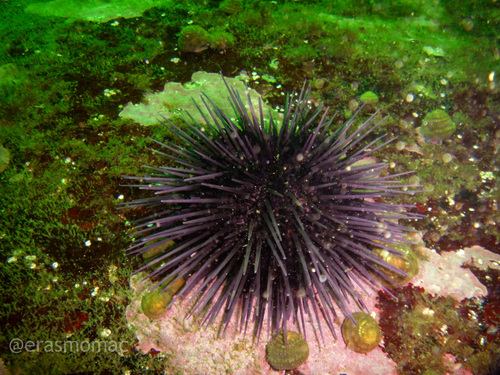
About Tetrapygus niger (Molina, 1782)
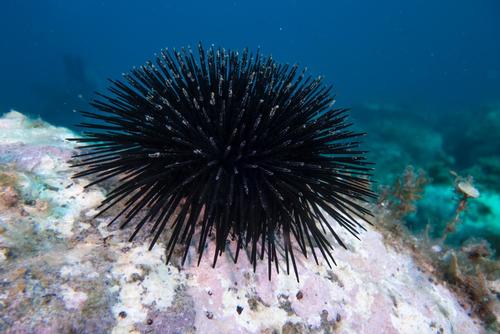
This species of sea urchin has the scientific name Tetrapygus niger (Molina, 1782). The oral (lower, under) surface of its hard calcareous test is flattened, while the aboral (upper) surface is shallowly domed. It has a small apical disc, and its ambulacral areas are straight. In the inter-ambulacral areas, rows hold up to five large primary tubercles, which are interspersed with smaller secondary tubercles. A sunken subpentagonal peristome, half as wide as the test, surrounds the mouth. Its primary spines are moderately long, and its secondary spines are short. The entire sea urchin is purplish-black in color. Also referred to as Arbacia nigra in this account, it is found in the southeastern Pacific Ocean along the coasts of Peru and Chile. Its range extends from northern Peru to the Strait of Magellan, and it occurs at depths down to about 40 m (130 ft). It is the most common sea urchin along this entire stretch of coast. Arbacia nigra is a herbivore that grazes on the kelp Lessonia trabeculata, which is the main constituent of kelp forests on the rocky coasts of Chile. Excessive grazing by this sea urchin prevents kelp recruitment: the urchin completely consumes young kelp plants, while it only feeds on the stipe (stalk) of older plants. Several species of starfish — Luidia magellanica, Meyenaster gelatinosus, Stichaster striatus, and Heliaster helianthus — prey heavily on grazing herbivores including T. niger. In 1998–1999, T. niger experienced a population explosion in northern Chile. This event was possibly linked to a decrease in the population of its predatory starfish species L. magellanica and M. gelatinosus; the decrease in starfish was probably caused by failed starfish recruitment resulting from the previous year's El Niño event. The population explosion led to the formation of "urchin barrens" — areas with no macro-algae, limited biodiversity, where rocks are covered only by encrusting coralline algae.