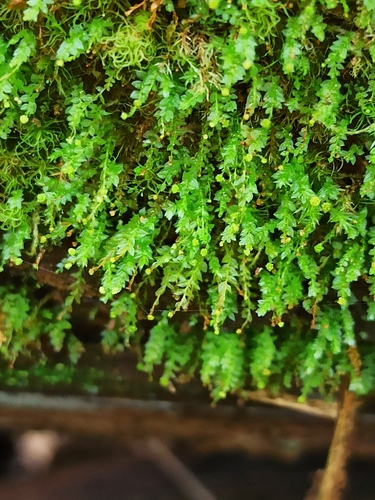
About Tetraphis pellucida Hedw.
Tetraphis pellucida Hedw. is a moss native to the Northern Hemisphere that grows almost exclusively on rotten stumps and logs. Its leafy shoots grow 8 to 15 mm tall. Lower leaves measure 1 to 2 mm long, while upper leaves and perichaetial leaves (the leaves that surround archegonia) reach 3 mm long. All leaves have smooth, entire margins. This moss reproduces both asexually via gemmae and sexually via spores produced by a sporophyte. For asexual reproduction, Tetraphis pellucida produces specialized reproductive propagules called gemmae, which grow in one of two structures: gemma cups or stalks. Gemma cups are formed from three to five larger specialized leaves, and hold gemmae in their center. Stalk gemmae are held in a terminal cluster on a small microphyllous stalk that extends 1 to 4 mm above the leafy gametophyte. Gemmae are most commonly dispersed by energy from falling rain. The shape of gemma cups lets them capture the impact energy of raindrops to propel gemmae outward. On average, gemmae from gemma cups travel 19.5 mm, while gemmae from stalks travel 13.3 mm. When gemmae are displaced by disturbance, cup gemmae travel an average of 12.1 mm, while stalk gemmae travel an average of 16.9 mm. For sexual reproduction, Tetraphis pellucida is dioicous, meaning antheridia (male reproductive structures) and archegonia (female reproductive structures) grow on separate gametophores. After fertilization of an archegonium, a sporophyte develops. The mature sporophyte has a 6 to 14 mm long seta, a 2 to 3 mm long capsule, and a 1 mm wide operculum. The fully developed capsule has four peristome teeth attached to its rim. Spores that develop inside the capsule are either smooth or finely roughened, and measure 10 to 13 micrometers across. Whether a Tetraphis pellucida colony uses asexual or sexual reproduction depends on shoot density. At low densities (fewer than 70 shoots per cm²), colonies produce no sporophytes, and all shoots are gemmiferous (gemma-producing). At densities over 70 shoots per cm², gametophores begin to develop, and at densities of 190 shoots per cm², colonies produce no gemmiferous shoots at all. At medium densities, archegoniophores (gametophyte shoots bearing archegonia) are more common than antheridiophores (gametophyte shoots bearing antheridia); as density increases further, antheridiophores become far more numerous than archegoniophores.

