About Tetraogallus tibetanus Gould, 1854
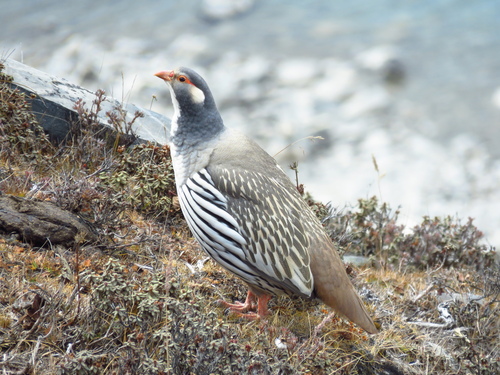
Tetraogallus tibetanus, commonly called the Tibetan snowcock, is smaller than the Himalayan snowcock. This species has a grey head and neck, with a white patch behind the eye and above its dark cheek. The chin, throat, and breast are white, with two grey bands crossing the breast. Grey wing coverts and tertials have white edging, and the secondaries have a broad white trailing edge that forms a visible wing band. The underparts are white, with black streaks on the flanks and belly. The tail is rufous brown, while the undertail coverts are black. Both the legs and beak are reddish. Males and females have similar overall plumage, but females have buff coloring in their postocular patch, plus blackish and buff markings on the sides of the head, neck, and breast-band. Females also lack the tarsal spurs that males have. Tibetan snowcocks inhabit alpine pastures and stony ridges above the tree line, found across the Pamirs of Tajikistan, the Himalayas from Ladakh to Arunachal Pradesh, Tibet, Pakistan, and China. During winter or periods of heavy snowfall, they move to lower altitudes. In some parts of their range, the distribution of Tibetan snowcocks and Himalayan snowcocks is clearly separated, while their ranges overlap in other areas. Because the Tibetan snowcock has a large distribution range with no observed population declines, the IUCN has classified it as a species of least concern. This species shares many traits with the Himalayan snowcock, but prefers to live at higher altitudes. In winter, they descend to lower altitudes and travel in groups called coveys. When approached from below on a hillside, they move upward, pausing occasionally to observe the intruder. When alarmed, they fly downward across valleys or ravines. Their flight is swift, and they often give a whistling call while in flight. They call multiple times while landing, and after settling from flight they shake their tails several times in the same manner as willow ptarmigan. They call during the morning and evening, and stay quiet around midday. They occupy grass-covered plateaus and ridges, as well as barren, stony plains with very little vegetation. While they do not post sentinels during feeding, one or more adult birds will perch on high boulders to keep watch while the flock rests at midday. They warn the rest of the flock of approaching danger with loud, prolonged whistles. Several distinct calls have been recorded for this species, including a chuckling call that gradually grows louder, a whistle, and a curlew-like call. During summer, they form breeding pairs, and males are believed to be monogynous. The nest is a shallow scrape sparsely lined with material, sheltered under a stone or bush, typically placed on the leeward side of a bare hill, and built in areas without vegetation. Females lay between 4 and 6 eggs. The male stands guard while the female incubates the eggs. Both parent birds stay with the brood after hatching. When the young are threatened, adults perform distraction displays, while chicks crouch or hide between stones. Broods from multiple females have been observed merging into a single foraging group.