About Tetraogallus himalayensis G.R.Gray, 1843
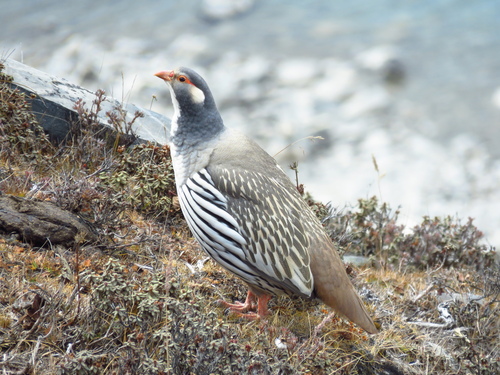
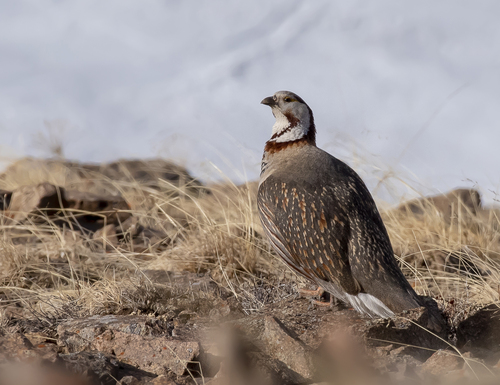
The Himalayan snowcock (Tetraogallus himalayensis G.R.Gray, 1843) is a large grey bird that resembles a partridge. It measures 55–74 cm (22–29 in) in length and weighs 2–3.1 kg (4.4–6.8 lb). Its head pattern is similar to that of the smaller, clearly marked chukar partridge. Its white throat and sides of the head are bordered by a chestnut moustachial stripe and a broad dark chestnut band that runs from the eye past the ear, expanding into a collar. Upper parts are grey, with rufous borders on the feathers of the rump and wings. The upper breast is grey with dark crescent-shaped bars. Lower breast plumage is dark grey, and the sides of the body are streaked with black, chestnut and white. Undertail coverts are white. Legs and orbital skin are yellow. Male and female plumage is identical, but females are smaller and lack the large tarsal spur found on males. When seen from above in flight, it is distinctive for its white primaries tipped in black and rufous outer tail feathers. By comparison, the Tibetan snowcock has a wing pattern with a white trailing edge to the secondaries that contrasts with its grey wings. The Himalayan snowcock lives in alpine pastures and steep mountain ridges of Central and South Asia, found above the treeline and near the snowline. In the Himalayas, it occurs at 4000 to 5000 m elevation in summer, and descends to 2400 m during severe winters. Because it has a large distribution range and no observed population declines, the IUCN has classified it as a species of least concern. In 1961, observers noted that the Himalayan landscape was similar to the Nevada region, and the Nevada Fish and Game Commission identified the Himalayan snowcock as a suitable game bird for introduction. The Commission requested birds from the President of Pakistan. The birds were wild-trapped in Hunza, and early shipments suffered heavy losses. After this loss, birds were reared locally at the Mason Valley game farm, and between 1965 and 1979 (a 15-year period), more than 2000 birds were released into the wild. A wild population of between 200 and 500 birds has become established in the Ruby Mountains, where they forage above the treeline. When not breeding, Himalayan snowcocks are gregarious, moving in small groups. Multiple groups may occupy the same hill. They stay entirely in open country and prefer rocky hillsides. They feed on grass, shoots, berries, and seeds. In the mornings, birds fly downhill to drink water. When approached from below their position, they attempt to climb up slopes on foot; when approached from above, they dive down valleys with open wings. In India, the breeding season falls in summer, from April to June. The species is silent in winter, but in spring its call is a common feature of the landscape. Its song is a loud three-part whistle with an ascending tone. They also produce a rising, shrill piping call. When feeding, they walk slowly uphill, picking tender grass blades and young plant shoots as they go. They have been recorded feeding on Ephedra berries, Artemisia leaves, grass shoots, bulbs, and the seed heads of a rye-like grass. In the Hunza range, they have been observed to prefer Sibbaldia cuneata. Once they reach the top of a hill ridge, they fly off to an adjacent hill, alighting some distance down the slope, and begin picking their way upwards again. When walking, they hold their tails upright to show their white undertail coverts. They are generally wary; when disturbed, they run uphill and then launch into flight from the ridge crests, reaching considerable speed. They face higher predation risk on alpine pastures than on steep slopes, and flocking helps them keep more watchers for predators, allowing more efficient foraging. In the Hunza range, flock sizes tend to be larger in rocky habitats, where they face risk of attack by Golden Eagles, than in grassy meadows. The breeding season is summer, from April to June. During courtship, the male crouches low to the ground with wings slightly spread, tail lowered, and feathers slightly ruffled. He then runs backwards and forwards in front of the female, or runs in circles. The nest is a bare scrape on the ground, sheltered under a stone or bush, usually located close to a ridge crest on the leeward side. Females lay 5 to 12 long, oval eggs, which are stony olive or brown and marked with scattered red or brown spots. Only the female incubates the eggs. Males are monogamous, and stay near the nest, often perching on an elevated rock to watch for intruders. If disturbed, the male warns the female with a loud whistle. If the hen is caught by surprise on the nest, she will not leave until approached very closely. Eggs hatched in an incubator after around 27–28 days. Adult Himalayan snowcocks are sometimes preyed on by golden eagles. Several species of endoparasitic Acanthocephala and Nematoda, including Hispaniolepis fedtschenkoi, have been recorded from this species.