About Tetrao urogallus Linnaeus, 1758
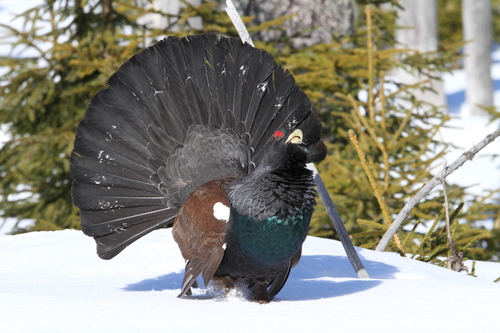
This description covers the western capercaillie, Tetrao urogallus Linnaeus, 1758. Adult male and female western capercaillie can be easily told apart by size and colouration. Males (cocks) are much larger than females (hens), and this species is one of the most sexually size-dimorphic living bird species. Only larger bustard types and a small number of pheasant family members have greater sexual size dimorphism. Typical cocks measure 74 to 85 cm (29 to 33 in) in length, with a 90 to 125 cm (35 to 49 in) wingspan, and an average weight of 4.1 kg (9 lb 1 oz). The largest wild cocks can reach 100 cm (40 in) in length and 6.7 kg (14 lb 12 oz) in weight. The heaviest recorded captive specimen weighed 7.2 kg (15 lb 14 oz). A survey of 75 wild cocks found their weights ranged from 3.6 to 5.05 kg (7 lb 15 oz to 11 lb 2 oz). Cock body feathers are dark grey to dark brown, while breast feathers are dark metallic green. Belly and undertail covert colour ranges from black to white based on the subspecies. Hens weigh roughly half as much as cocks. A capercaillie hen measures approximately 54–64 cm (21–25 in) from beak to tail, has a 70 cm (28 in) wingspan, and weighs 1.5–2.5 kg (3 lb 5 oz – 5 lb 8 oz) with an average of 1.8 kg (3 lb 15 oz). Hen upperbody feathers are brown with black and silver barring, while underside feathers are paler and buffish yellow. Both sexes have a white spot on the wing bow, and feathered legs that provide extra cold protection especially in the cold season. Rows of small, elongated horn tacks on their toes create a snowshoe effect. This trait gives the group its German name Rauhfußhühner, literally "rough-footed hens". These tacks leave clear tracks in snow, and the footprints of males and females are easily distinguishable by size. Both sexes also have a bright red patch of bare skin above each eye, which German hunters call "roses". Newly hatched chicks have cryptic colouration matching the hen, which acts as passive protection from predators. Chicks also have black feathers on their crowns. By around three months old in late summer, chicks gradually moult into the adult plumage for their sex. Capercaillie eggs match chicken eggs in size and shape, but have more brown speckling. The western capercaillie is a non-migratory, sedentary species that breeds across northern Europe and the Palearctic, in mature conifer forests with diverse species composition and a relatively open canopy. It once occurred across all Palearctic taiga forests in cold temperate latitudes, and across the coniferous forest belt in the mountain ranges of warm temperate Europe. The native Scottish population went extinct, but the species has been reintroduced there using Swedish stock. In Germany, the western capercaillie is listed as threatened with extinction on the national Red List; it is no longer found in lower mountainous areas of Bavaria, and populations continue to decline in the Bavarian Forest, Black Forest and Harz mountains even with intensive captive breeding and release efforts. In Switzerland, populations live in the Swiss Alps and the Jura mountains. In France, the largest population occurs in the Pyrenees, small struggling populations live in the Jura and Vosges Mountains, and fewer than 20 individuals remain in the Cévennes where the population is on the brink of extinction. It is extinct in the French Alps, but still present in the Austrian and Italian Alps. The species was common in Ireland until the 17th century, and was extirpated there by the 18th century. Populations are large and the bird is common in forested areas of Norway, Sweden, Finland, Russia and Romania; it is the regional bird of Central Finland and appears on the region's coat of arms. The most severe threats to the species are habitat degradation, especially when diverse native forest is converted to single-species timber plantations, and collisions with fences built to exclude deer from young plantations. In some areas, populations are also impacted by increased numbers of small predators that prey on capercaillie, such as red fox, which results from the loss of large predators that naturally control smaller carnivore populations, such as the gray wolf and brown bear. The western capercaillie is adapted to its original habitat: old coniferous forests with a rich interior structure and dense ground vegetation of Vaccinium species under a light, open canopy. They feed mainly on Vaccinium species, especially bilberry, use young tree growth for cover, and rely on open spaces for flight. As habitat specialists, they barely use any other forest types. Due to their large body weight and short, rounded wings, western capercaillies are not agile fliers. When they take off, they produce a sudden loud thundering noise that deters predators. Their size and wingspan mean they avoid young, dense forests when flying. During flight, they pause for short gliding phases, and their feathers produce a whistling sound. Hens with young chicks specifically need a small-scaled patchy mosaic of key resources: food plants, small insects for chicks, cover in dense young trees or tall ground vegetation, and old trees with horizontal branches for sleeping. These habitat requirements are best met by old forest stands with spruce and pine, dense ground vegetation, and local tree regrowth on dry slopes facing south to west. These open stands allow downslope flight, and tree regrowth provides necessary cover. In lowlands, this forest structure developed over centuries through heavy human exploitation, particularly litter harvesting and livestock grazing. In highlands, along mountain ridges in temperate Europe, and across the taiga region from Fennoscandia to Siberia, boreal forests naturally have this open structure due to harsh climate, creating optimal capercaillie habitat without human input. Dense young forests are avoided, as they provide neither cover nor food, and severely impede the large birds' ability to fly. Western capercaillie abundance depends on habitat quality, like most species. The highest abundance is found in sunlit, open, old mixed forests with spruce, pine, fir and some beech, that have a rich ground cover of Vaccinium species. Spring territories measure around 25 hectares (62 acres) per bird, and similar abundances occur in taiga forests. Because of these habitat needs, the species never reached particularly high population densities, despite stories spread by hunters. Adult cocks are strongly territorial, and occupy ranges of 50 to 60 hectares (120 to 150 acres) in optimal habitat. Hen territories are around 40 hectares (100 acres) in size. The annual home range can reach several square kilometres (hundreds of hectares) when storms and heavy snowfall force birds to move to lower altitudes for winter. Cock and hen territories may overlap. Western capercaillie are diurnal, meaning they are only active during daylight hours. They spend nights in old trees with horizontal branches. The same sleeping trees are used for multiple nights, and can be easily identified because the ground under them is covered in bird droppings. Hens nest on the ground and spend nights on their nest. As long as young chicks cannot fly, the hen roosts with them in dense ground cover. During winter, hens rarely descend to the ground, so most snow tracks come from cocks. The western capercaillie breeding season starts between March and April, depending on spring weather, vegetation growth and altitude, and lasts until May or June. Three-quarters of this long courting season consists of territorial competition between neighbouring cocks or cocks sharing the same courting ground. Tree courting begins at early dawn on a thick branch of a lookout tree. The cocks positions itself with raised fanned tail feathers, an erect neck, beak pointed upward, wings held out and drooped, and performs a characteristic display call to attract females. The display call is a sequence of double clicks similar to a falling ping-pong ball, that gradually accelerate into a popping sound like a champagne cork releasing from a bottle, followed by scraping sounds. Hens arrive on the courting grounds (called leks, from the Swedish word for "play") towards the end of the courting season, which is the main courting period. Cocks fly from their courting tree to a nearby open space and continue their display. Hens ready to mate crouch and produce a begging call. When multiple cocks share a lek, the alpha cock is the one that mostly mates with the hens. Western capercaillies are extremely sensitive to disturbance during this phase. Even a single human observer can cause hens to flush and prevent copulation during the short window when they are able to conceive. In Scandinavia and Scotland, male western capercaillies are known for aggressive behaviour during the mating season, and will sometimes challenge and chase people that enter their territory. One study found that testosterone levels in these aggressive "deviant" males were around five times higher than levels in normal displaying males. A smaller secondary courting peak occurs in autumn, which serves to establish territories for the coming winter and next breeding season.