About Tetraneuris herbacea Greene
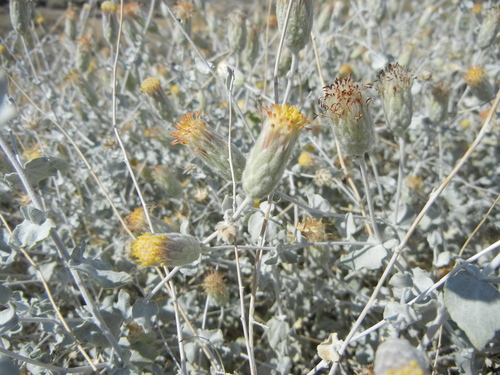
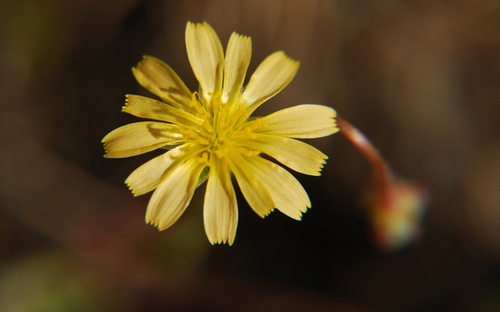
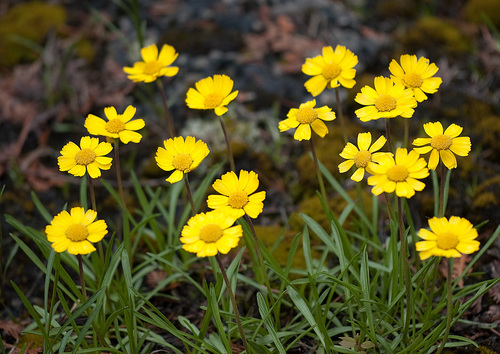
Tetraneuris herbacea Greene is a perennial herb that grows from a branching caudex, producing one or more erect stems 6 to roughly 35 centimeters (2.4 to 14.0 inches) tall. Its leaves grow around the base of the plant, and have rubbery, glandular blades. The inflorescence takes the form of a single flower head carried on a hairy peduncle. The flower head holds 50 to 250 yellow disc florets, which are surrounded by 7 to 27 yellow ray florets (occasionally zero), each measuring 1 to 2 centimeters (0.4 to 0.8 inches) long. The fruit this plant produces is an achene tipped with a pappus made of scales.
This species is known from only a small number of natural and introduced populations. In Ontario, around 20 populations all grow on the shores of Lake Huron on the Bruce Peninsula and Manitoulin Island. In Ohio, this plant occurs naturally only in Ottawa County, where it can be found at Lakeside Daisy State Nature Preserve, a protected area named for this species. There is also an introduced population of the species on Kelleys Island, Ohio. In Illinois, naturally occurring populations were last recorded in 1981, and all existing populations there today are introduced populations located in nature preserves. In Michigan, there is one population in Mackinac County on the Upper Peninsula, and this population may or may not be naturally occurring.
Tetraneuris herbacea grows on alvars, a type of limestone pavement that supports very little plant cover. These rocky outcrops have thin, alkaline soils, and become very dry during dry seasons. These conditions are inhospitable to most other plant species, so the lakeside daisy grows in unshaded full sun. In Michigan, the plant’s habitat forms on tufa and marl, which are different types of limestone substrate.
This species is threatened by habitat loss. The natural limestone plain that hosts the largest United States population of the plant, located in Ohio, is privately owned by a quarrying company that mines the rock. Quarry spoils are dumped directly on top of clumps of the plant. Recreational activities such as off-road vehicle use also damage its habitat. In some areas where the plant grows, the absence of a natural fire regime allows ecological succession to proceed in the nearly barren habitat, leading to growth of woody vegetation that blocks sunlight the plant needs. This plant is restricted to a rare habitat type, and all of its populations are small. Because each individual plant requires pollen from an unrelated individual to reproduce, small, widely spaced populations make successful reproduction difficult for the species.