About Tetraneuris acaulis (Pursh) Greene
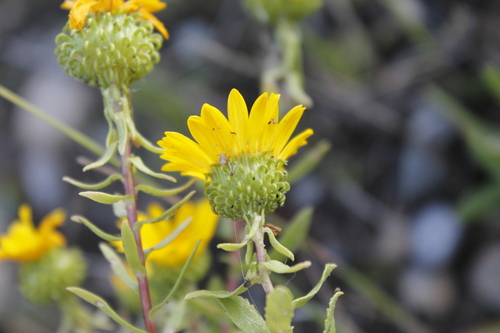
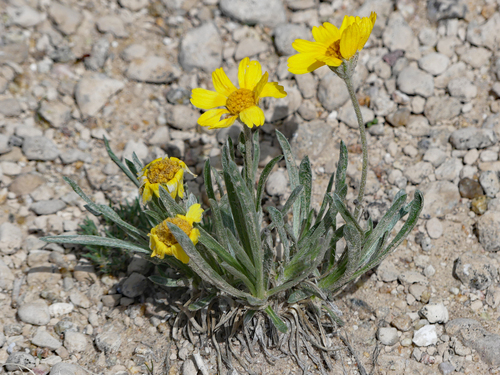
Tetraneuris acaulis is a highly variable perennial plant that grows from a large, coarse taproot. When flowering, its height can range from just 2 centimeters to over 30 centimeters; it may be a moderately sized or extremely short herbaceous plant. This species does not produce aboveground stems, all its clustered leaves grow directly from the plant's base at ground level as basal leaves. The leaves are tightly packed, and may be spoon-shaped (spatulate), or shaped like a spear head with the widest section in the distal third (oblanceolate), sometimes very narrowly shaped (linear-oblanceolate). Leaf edges have no teeth or divisions, and leaves may be either hairy or smooth. Each flowering stem holds a single flower head at its tip, though very rarely a single stem may produce two flower heads. The flowering stem is a leafless scape, and an individual plant can grow between 1 and 35 flowering stems, occasionally producing as many as 60. Flowering stem length is also quite variable, ranging from 0.5 to 30 centimetres (0.2 to 10 inches). Flower heads hold a large number of small disc flowers, ranging from 25 to over 200. The ray flowers along the edge of the head usually number 8 to 15, and may occasionally reach 21 in count. The petal-like ligules are showy, 5–20 mm (1⁄4–3⁄4 in) long and 3–8 mm (1⁄8–5⁄16 in) wide. Both ray and disc flowers are predominantly bright yellow; some plants produce no ray florets at all. Within its native range, it can flower any time from April to October, with different varieties having slightly different flowering seasons. Its fruits are dry achenes that are only a few millimeters long. This species is very widespread across the United States, ranging from Texas and California in the south to Idaho and North Dakota. East of the Rocky Mountains, it grows on the western Great Plains, found in the northern Texas panhandle, and the westernmost counties of Oklahoma, Kansas, Nebraska, South Dakota, and North Dakota. It is found throughout the Rocky Mountain states of Montana, Wyoming, and Colorado, as well as across almost all of New Mexico, and only occurs in the southeast corner of Idaho. It also grows in the northern half of Arizona, the eastern half of Nevada, and San Bernardino County (a desert county) in California. In Canada, it occurs in the prairie provinces of Alberta and Saskatchewan. In Saskatchewan, a single non-reproducing colony of the plant is found on the Missouri Coteau 11–12 kilometers south of Mortlach. In Alberta, it is found in Writing-on-Stone Provincial Park. It grows in a wide variety of habitat types, including foothills, subalpine regions, high prairie, badlands, and plains. In an experiment marking individual native bees at California nurseries that grew native plants, researchers found bees chose to revisit Tetraneuris acaulis blooms at a higher than expected rate. Conservation non-profit NatureServe evaluated this species in 2016, and ranked it as globally secure (G5), a conservation status indicating the species is common and widespread with no long-term threats or significant population declines. At the state and provincial level, it is ranked secure (S5) in Utah and Wyoming, apparently secure (S4) in Montana, vulnerable (S3) in Alberta and Nevada, and imperiled (S2) in Saskatchewan. It has not been evaluated at the state or provincial level across the rest of its range. Tetraneuris acaulis has been used as a traditional medicinal plant. The Hopi people used a poultice made from the plant to relieve hip and back pain in pregnant women, and also used it to make a stimulating drink. Stemless four-nerve daisies are cultivated by gardeners for rock gardens, including in areas outside the species' native distribution. It is also grown in regions where water use is a concern, because it has very low water requirements. To keep plants compact, growers plant them in lean soils with little organic content, though the species is not sensitive to its soil requirements. It requires full sun, and a dry slope is an ideal planting location. The salt tolerance of a cultivated selection of Tetraneuris acaulis var. arizonica was tested at Utah State University, and found to be very high compared to many other cultivated plants. In cultivation, stemless four-nerve daisy may bloom in late spring or early summer. Its foliage is aromatic. It is winter hardy in USDA zones 4–8, surviving temperatures as cold as −35 °C (−31 °F). Its seeds have very little to no requirement for cold stratification to germinate. One experiment recorded 100% germination within 3–5 days at a temperature of 21 °C (70 °F). However, it does not reproduce from seed very readily in garden settings, which limits its spread in formal plantings.