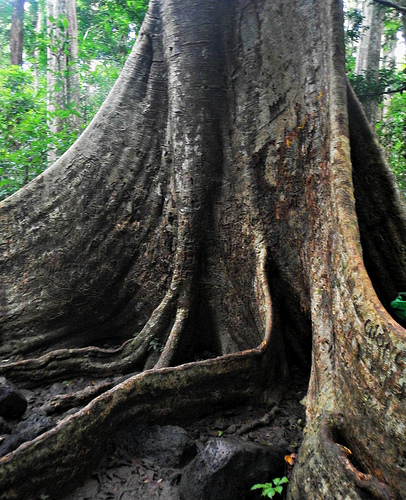
About Tetrameles nudiflora R.Br.
Tetrameles nudiflora R.Br. is a large dioecious tree that can reach over 45 m in height with a canopy spread of over 10 m. Its trunk is buttressed, with grey, often shiny bark, and the trunk or branches frequently contain large hollows. It is a deciduous species; in Australia, it loses its leaves between October and December, while it is typically leafless from January to April in Vietnam. The genus name comes from the Ancient Greek words tetra, meaning 'four', and melos, meaning 'part', referring to the four sepals of its flower. The species name nudiflora comes from the Latin phrase meaning 'bare flowers'. The largest recorded tree in Thailand belongs to this species. Dendrologist Marc Meyer measured this specimen on 29 February 2016 using a Nikon Forestry 500/pro laser, recording its height as exactly 64.20 m (210.6 ft) and its girth as exactly 24.20 m (79.4 ft). Tetrameles nudiflora is a subtropical and tropical forest species native to India, Sri Lanka, Bangladesh, Bhutan, Myanmar, China, Laos, Cambodia, Thailand, Vietnam, Malaysia, Indonesia, East Timor, Papua New Guinea, and Cape York Peninsula in north Queensland, Australia. In India, it occurs in particularly high numbers in Thattekad Bird Sanctuary, Kerala. In Myanmar, an old specimen around 60 m (200 ft) tall grows on the University of Yangon campus. In Vietnam, where the species is called tung or thung, several large, well-formed specimens are presented to visitors at Cat Tien National Park, with one located within walking distance of the park headquarters. Many individual Tetrameles nudiflora grow to very large height and width. Because of its large size, this species is suited for planting in nature reserves, parks, and other large open spaces, rather than private gardens. Even though its timber is soft, it is used to construct canoes in New Guinea. T. nudiflora does not need deep soil to grow, and it acts as a useful pioneer coloniser species for forest regeneration.

