About Tetraloniella dentata (Germar, 1839)
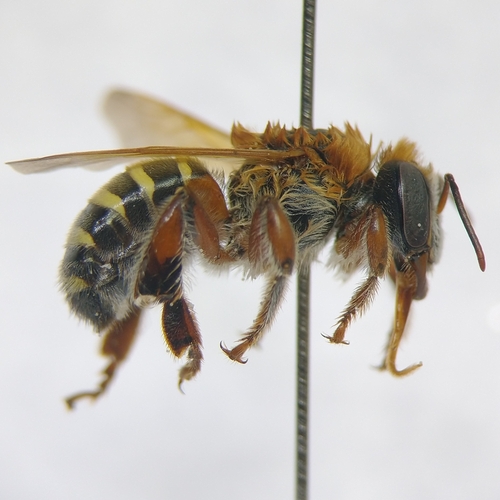
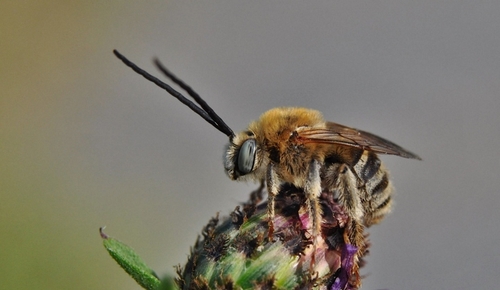
Tetraloniella dentata (Germar, 1839) measures 12 to 14 mm in total length. Males are similar in appearance to females, but have distinctly longer antennae. The clypeus of this species is yellow. Females have rust-red colored hair covering the mesonotum. The edge of the tergite is wide, smooth, and shiny. Tetraloniella dentata is distributed across North Africa from Morocco to Tunisia. In Eurasia, its range extends from Portugal, through southern and central Europe, Asia Minor, the Levant, and the Caucasus, all the way to Central Asia. Its northern range reaches the Baltic States, and extends into Russia as far east as Kirov and Perm. Its southern range extends to Sicily, Greece, Israel, and Northern Iran. Several named subspecies are recognized across its range: the subspecies atlantis (TKALCU, 1998) occurs in North Africa; subspecies amseli (ALFKEN, 1938) occurs in Sardinia; subspecies macrozona COCKERELL, 1922 is found in Pakistan; and subspecies extrema (TKALCU, 1998) was described from Mongolia. In Germany, the species is currently only recorded from Brandenburg. Historically, it has been recorded from Mecklenburg-Western Pomerania, Saxony-Anhalt, Hesse, and Thuringia. It once occurred further south in Germany, but populations in those southern areas have disappeared, and the species is now restricted to the northeast German lowlands, where it remains very rare. In Austria, it has been reported from Burgenland and Lower Austria. In Switzerland, it is currently found in Valais, and was historically reported from Ticino and Misox. This species occupies dry, warm locations including vineyards, fallow land, ruderal areas, sand and clay pits, and steep banks. It occurs from low elevation up to montane elevation. In Germany, it is found in large sandy areas north of the low mountain range, such as Döberitzer Heide. Within these areas it uses sandy, dry, warm ruderal spots, and constructs nests on south-facing embankments with sandy subsoil, among other sites. Tetraloniella dentata is a univoltine species, meaning it produces one generation per year. Adults fly from July to September. It is an oligolectic bee that specializes on collecting pollen from plants in the Asteraceae family, particularly the Cardueae tribe. Its main pollen sources are Centaurea stoebe, and it also uses pollen from Centaurea scabiosa, Carduus acanthoides, and Onopordum acanthium. This bee digs its own nesting cavities in the earth. Nests are built in bare or sparsely vegetated soil, on flat to sloping surfaces in self-excavated corridors. The overall nest structure is similar to that of Eucera macroglossa. Brood cells are located at depths of 12 cm or more below the surface. The entrance to the nest is surrounded by a tumulus of excavated soil. The nest is formed around a typically branched main passage. The species prefers to nest in sand, loess, or loess clay, which can be compacted. Ammobates vinctus and Triepeolus tristis are documented cuckoo bees that parasitize nests of Tetraloniella dentata.