About Tetragonus catamitus Geyer, 1832
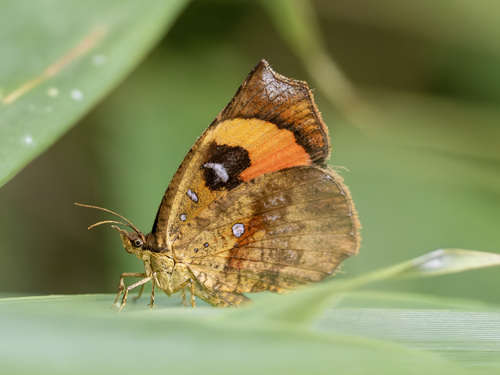
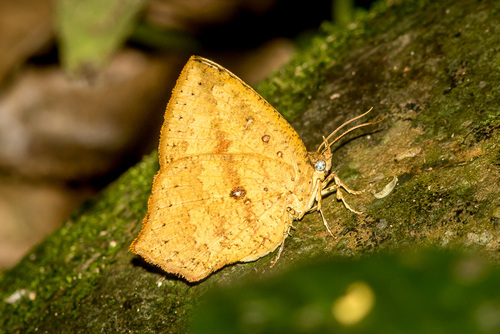
The head, thorax, and abdomen of Tetragonus catamitus Geyer, 1832 are dark yellowish and reddish brown. All wings are yellowish and reddish brown, with hindwings showing a more uniform reddish brown color. On the underside of the wings, dark striations are present, and both forewings and hindwings have three grey spots in the discal cell. Four pale rufous bands run along the medial, postmedial, and submarginal regions. This species is distributed across lowland seasonal or tropical forests in east and south-east Asia, where its host fern species are abundant. Kobes (1990) recognized three subspecies of this species, but Holloway (1998) treated all three as junior synonyms of the nominotypical subspecies, and noted that the species shows great variation in size and colouration. Tetragonus catamitus occurs in lowland forests, particularly in boggy areas where its feeding and host plants grow densely. The species prefers shady, bushy habitats during the daytime, though individuals can occasionally be seen outside these preferred areas. It is most active during rainy conditions, just after dark in the evening around lights, or during early mornings.