About Tetragonisca angustula (Latreille, 1811)
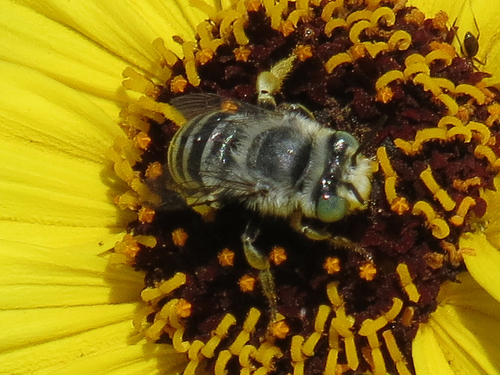
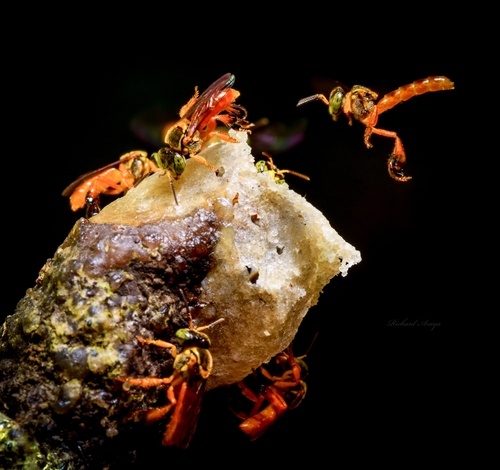
Tetragonisca angustula is an exceptionally small stingless bee, measuring approximately 4–5 mm long. As a member of the tribe Meliponini, it shares the group’s characteristic traits: it cannot sting, has reduced wing venation, and bears penicilla, which are bristles on the leg. Two recognized subspecies can be distinguished by the color of their mesepisternum: T. angustula fiebrigi has a light yellow mesepisternum, while T. angustula angustula has a black mesepisternum. Within each hive, guard bees make up 1–6% of the population. Compared to foragers of this species, guard bees weigh around 30% more, have smaller heads, and longer hind legs. Unlike most other stingless bees, T. angustula exhibits a pronounced size dimorphism between its queen and worker castes. This species has a very large distribution across Central and South America, ranging as far north as Mexico and as far south as Argentina, and has been described as one of the most widespread bee species in the neotropics. The two subspecies occupy different general ranges: T. angustula fiebrigi occurs more in the southern portion of the species’ range, found in parts of Brazil, Argentina, Paraguay and other southern South American countries. T. angustula angustula is more common in the northern portion of the range, with a larger presence in Brazil and found in Panama, Venezuela, Costa Rica, Nicaragua and other northern neotropical countries. The distribution of T. angustula overlaps with the ranges of many other stingless bee species, and it has a particularly strong overlap with the distribution of Paratrigona subnuda across Mesoamerica. In the Atlantic rainforest, extensive deforestation to create sugar cane plantations has led to T. angustula becoming rare in this area, along with the stingless bee Melipona scutellaris. T. angustula builds nests in a wide variety of settings. Their nests are the most common bee nests in recovering forest habitats, but the species is also found nesting in structured intact forests, depleted forests, and urban areas. Like other stingless bees, T. angustula uses pre-existing cavities as nest sites, including holes in tree trunks, cavities in walls, and even abandoned ant or termite nests.