About Tetragonia decumbens Mill.
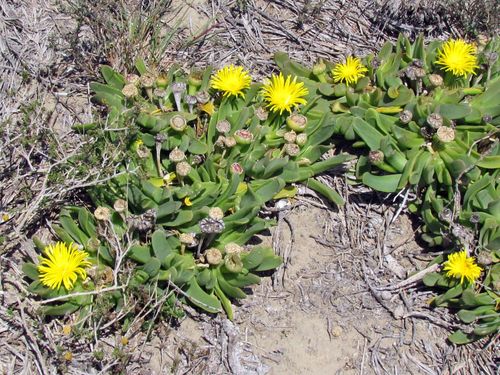
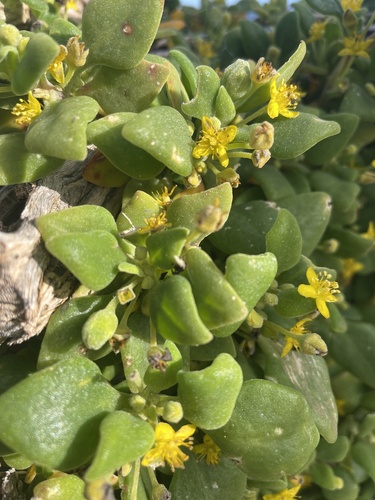
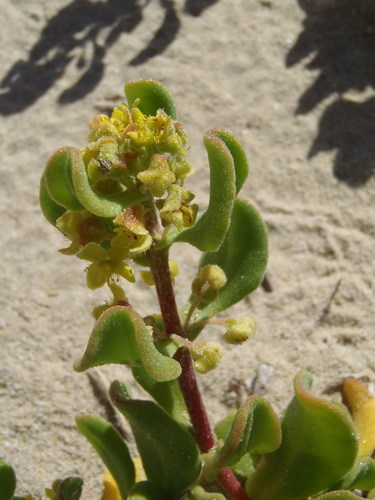
This species, scientifically named Tetragonia decumbens Mill., grows as a trailing undershrub. It has thick, pale, furry stems, and thick, oval, saddle-shaped leaves that measure 10–60 millimetres long and 5–30 millimetres wide. Its flowers grow in clusters of three to five, with four light yellow perianth segments surrounding a center that holds many stamens. It produces a succulent fruit with four wings, which matches the meaning of the genus name Tetragonia, meaning "four-angled". It is native to southern Africa, where it grows on coastal and estuarine sand dunes in Namibia and the Cape Provinces of South Africa. The plant is edible, and is a local delicacy in its native southern Africa, where it is commonly called "dune spinach". It is an important component of dune vegetation: it is a hardy pioneer species that stabilizes dunes, and the organic material it produces creates suitable conditions for subsequent plants to grow. It has become naturalized in Australia, where it is known as "sea spinach". In Australia, it occurs in Western Australia, South Australia and New South Wales; specimens from New South Wales were long misidentified as Tetragonia nigrescens. It was also formerly naturalized in Victoria, Australia, but is now considered extinct there.