About Tetragnatha montana Simon, 1874
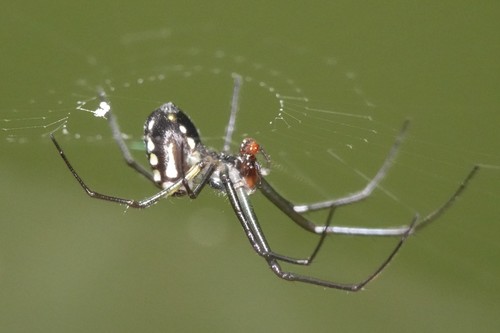
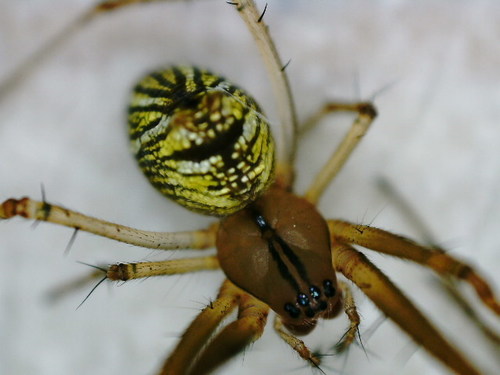
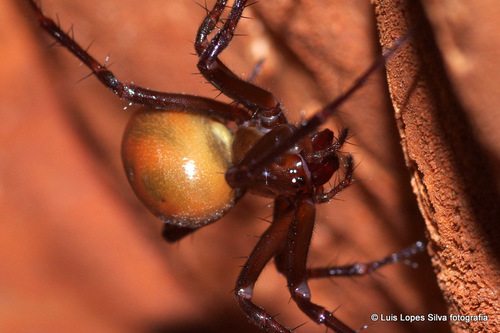
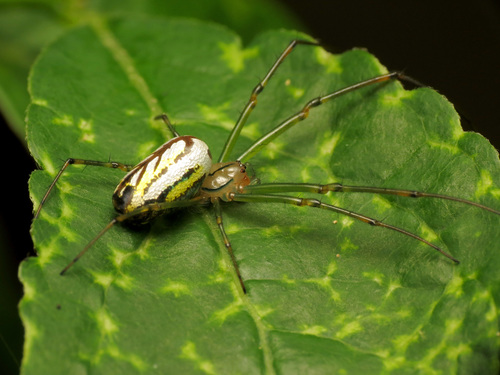
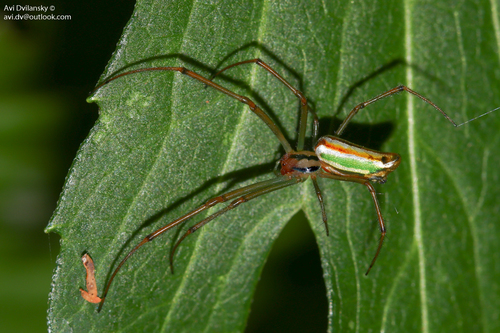
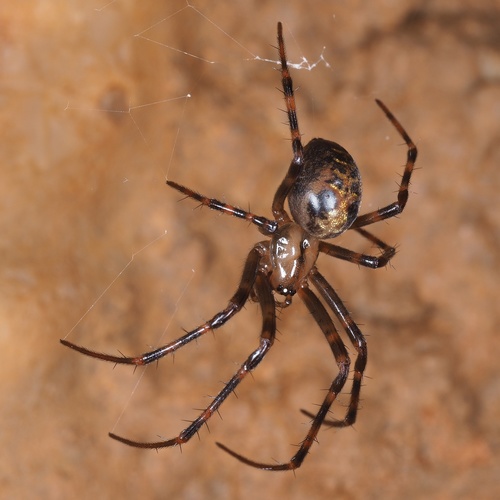
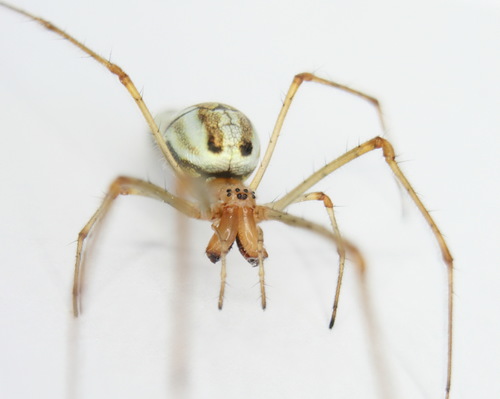
Tetragnatha montana Simon, 1874 shows clear sexual size dimorphism: females have a body length of 7–13 mm, which is larger than males, whose body length ranges from 6–8 mm. In males, the paracymbium, a genital appendage growing from the base of the cymbium, has a predominantly hook-shaped lateral process. In females, the posterior margin of the epigynal plate of the epigyne is straight or convex. The prosoma is yellow-brown, and the sternum ranges from dark brown to black. This species has yellow-brown chelicerae; on male chelicerae, a small round tubercle sits next to the dorsal tooth. The legs are yellow-brown, and the dorsal surface of the opisthosoma is silver. The opisthosoma is elongated, has a silver-white leaf shape outlined in gold, with golden wavy borders along its margins and black lines that can sometimes be quite thick. The ventral surface of the opisthosoma is brown. Males have very similar abdominal markings to females, but their abdomen is a darker reddish-gold, colour contrasts are less obvious than in females, and the white or silvery areas are far less extensive. The male ventral abdomen is brown, with undulating borders and a darker band running along it. Legs differ noticeably between the sexes in length, colour, and shape: female legs are brown, beige, or yellow-brown, while male legs are darker. Leg pairs 1, 2, and 4 are very long, while leg pair 3 is relatively short. When the spider rests, it uses the third pair of legs to hold onto thin twigs or grass, and extends the other three pairs. In both sexes, dark rings and spots are often present on the legs close to the claws.
T. montana is widespread across much of the Palearctic realm, ranging from Western Europe to East Asia, as far north as southern Norway and as far south as Iran. It is the most common Tetragnatha species in many parts of Europe. In Great Britain, it is widespread in the south, and becomes localised in the north. T. montana builds its webs on trees, bushes, and low vegetation across a variety of mostly lowland habitats. Its webs can be found close to water, but it is less closely associated with wetland habitats than its congener Tetragnatha extensa.
Male T. montana do not initiate mating through courtship. To avoid being bitten by the female, the male locks the female's chelicerae in his own using a spur, and he escapes after mating is complete. After mating, the female produces a dark green cocoon to hold her fertilised eggs, and this cocoon is encased in a fine white web. The cocoon is attached to vegetation, most commonly leaves. The female guards and protects the cocoon from predators until the spiderlings hatch, which occurs after around 100 days. Molecular markers in the form of allozymes have confirmed that wild-collected female T. montana mate with multiple males, which indicates that sperm competition is potentially an important driver shaping the evolution of this species' mating system.