About Tetraena alba (L.fil.) Beier & Thulin
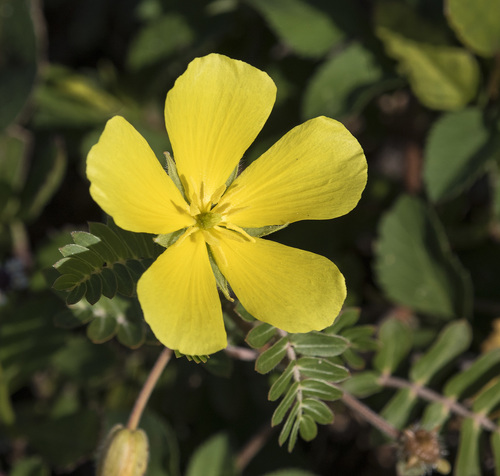
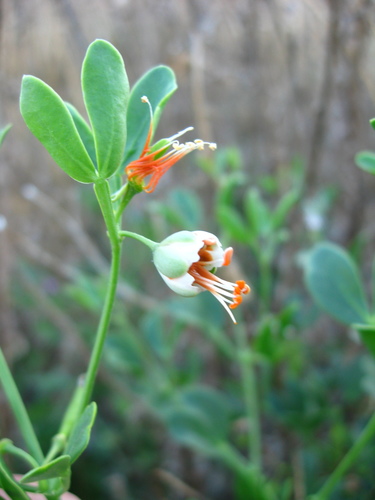
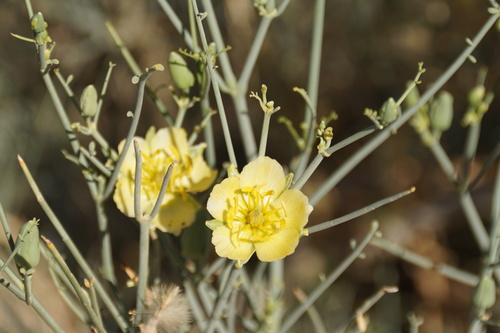
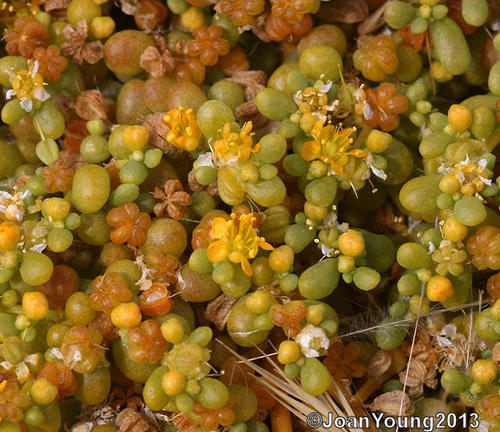
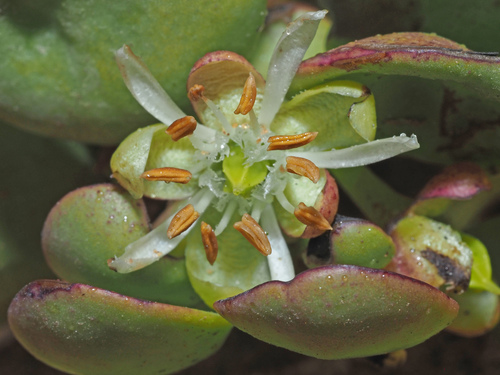
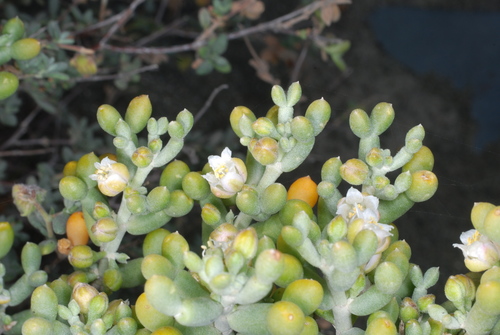
Tetraena alba (basionym Zygophyllum album) is a low, heavily branched shrub. Its leaves bear paired obovoid, fleshy leaflets that are whitish and covered in mealy hair-like pubescence. Small, solitary flowers grow in the leaf axils, and each flower has white petals with a narrow clawed base. The fruit is a five-lobed, pear-shaped capsule that holds elliptical seeds marked with wart-like projections. This species is distributed across Spain, Crete, northern and northeast Africa, Mauritania, western Asia (including southern Cyprus, the Eastern Aegean Islands, and the Sinai Peninsula), and the Arabian Peninsula. Tetraena alba is a salt-tolerant plant that lacks glands to secrete excess absorbed salt; instead, it concentrates salt in its leaves and sheds these salt-filled leaves, and will also shed its petioles when needed. It grows in a range of different habitats. One common habitat is phytogenic hillocks, which are hummocky landforms typical of areas with blown sand. Another common habitat is saline depressions, where it sometimes grows in pure single-species stands, and other times occurs as the dominant species in its plant community. Other salt-tolerant species that grow alongside T. alba in these communities include Halocnemum strobilaceum, Nitraria retusa, and Limonium axillare. At Moghra Oasis in the Qattara Depression, where a brackish lake and Phragmites swamp are present, T. alba grows along the perimeter where the desert plains begin. In the innermost section of this perimeter zone, it forms hummocks and grows alongside Tamarix nilotica, Alhagi maurorum, and Nitraria retusa. In the outermost section of the zone, plants are sparse, do not form mounds, and become progressively smaller further outward.