About Tetradymia spinosa Hook. & Arn.
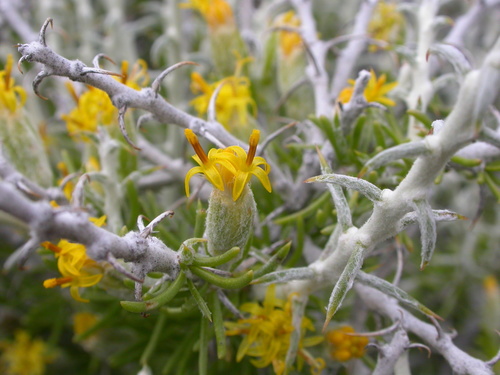
Tetradymia spinosa Hook. & Arn. is a species of flowering plant in the aster family, known by the common name shortspine horsebrush. It is native to the western United States, especially the basins and plateaus west of the Rocky Mountains. It grows in sagebrush, woodlands, and scrub habitat, often among shadscale in alkaline areas such as playas. It is a bushy shrub with many branches coated in woolly white fibers, growing to a maximum height around one meter. The leaves are narrow, curving, and hooklike, hardening into sharp spines up to 2.5 centimeters long. The inflorescence bears one or two flower heads, each enveloped in four to six woolly phyllaries. Each head contains up to 8 tubular yellow disc flowers up to 1 centimeter long. The fruit is a densely hairy achene which may be nearly 2 centimeters long, including its pappus of long bristles. The plant is extremely toxic, although it is unpalatable and unlikely to be eaten. Consumption causes liver damage and extreme light sensitivity, which in combination may be deadly. This light sensitivity effect is caused by a pigment entering the superficial circulatory system, producing a sunburn-like effect as well as swelling around the head in light-colored animals, particularly sheep.