About Tetradesmus obliquus (Turpin) M.J.Wynne
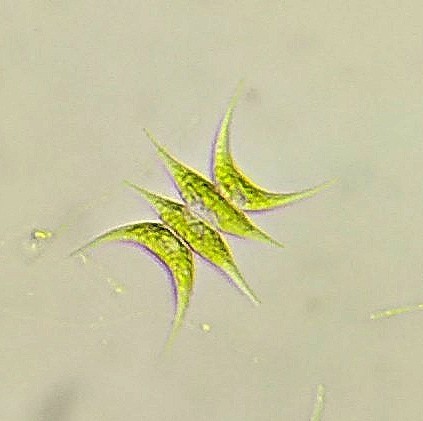
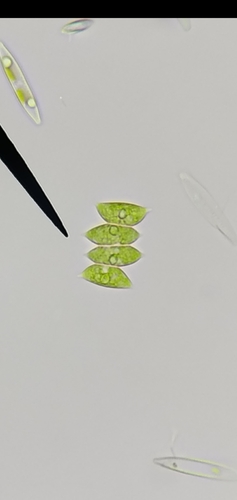
Tetradesmus obliquus (Turpin) M.J.Wynne is a species of green algae in the family Scenedesmaceae. It is most widely known under its synonym, Scenedesmus obliquus. This is a common species that occurs in a wide variety of freshwater habitats. Tetradesmus obliquus typically forms colonies of two to four cells, and occasionally up to eight cells, arranged in a single row; when grown in culture, solitary individual cells are often observed. The cells are spindle-shaped, ranging from (4–)6–15(–25) micrometers in length and 2.2–9.6(–11) micrometers in width. Their ends taper to sharp, acute points, and cells are sometimes slightly asymmetrical. Each cell contains a single chloroplast that fills the entire cell, with a pyrenoid located at the center. This chlorophyte species is notable for the genetic code of its mitochondria, where the codon TCA is translated as a stop codon, and the codon TAG is translated as leucine. This specific genetic code corresponds to NCBI translation table 22, the Scenedesmus obliquus mitochondrial code. Tetradesmus obliquus is the subject of growing biotechnological interest for applications including biofuel production, aquaculture, and wastewater treatment. The growth and photosynthesis of Tetradesmus obliquus are impacted by the presence of nano-sized microplastics, such as nano-polystyrene (nano-PS).