About Tetractenos glaber (Fréminville, 1813)
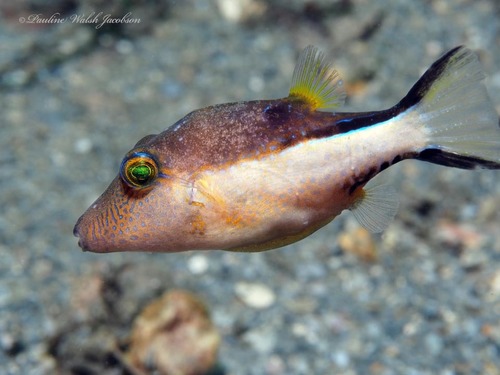
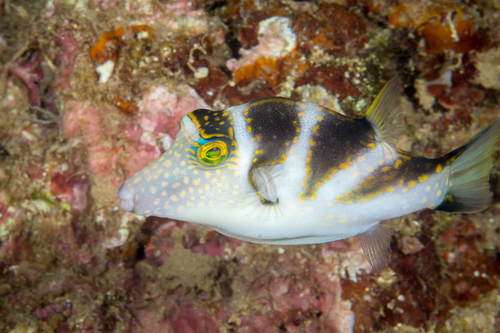
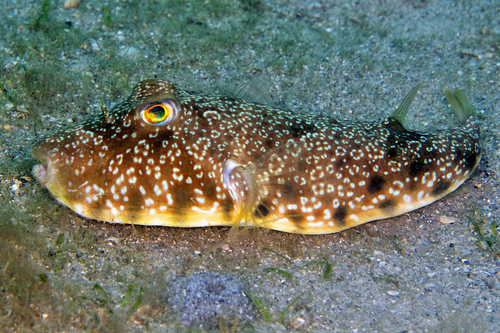
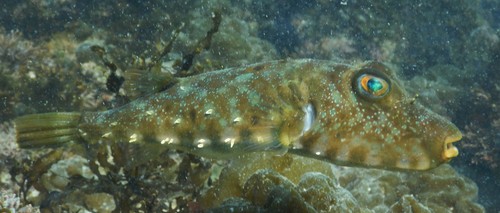
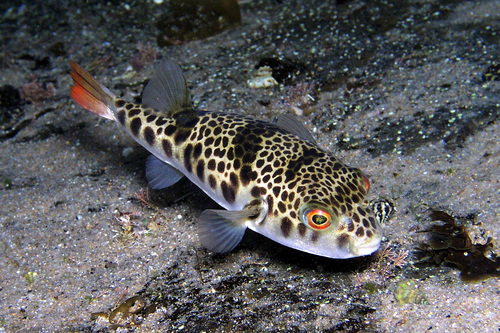
The smooth toadfish, with the scientific name Tetractenos glaber, has adult total lengths ranging from 3 to 16 cm (1+1⁄8–6+1⁄4 in). It has an elongate body with a rounded back, flattened belly, and narrows posteriorly into a slender tail; all of its fins are elongate and rounded. The dorsal fin holds 9 to 11 rays, the pectoral fin has 15 to 18 rays, with the first ray being very short, and originates well below eye level. The anal fin has 7–9 rays, and the caudal fin has 11 rays. This species has a small mouth with thin lips at the snout tip and a tiny chin. Its round non-rotatable (adnate) eyes sit with upper edges level with the back's profile, and lower edges well above the mouth. Two small nipple-shaped nasal papillae sit in a slightly depressed area just in front of the eyes; their openings face backward and are closed by flaps attached to the walls closest to the fish's midline. Its first pharyngobranchial gill arch is elongated and narrow, and covered in many tiny teeth. The smooth toadfish has tiny spines entirely embedded within the skin layer, running along the back from the nasal organs almost to the dorsal fin, along the sides from the eye to the pectoral fin, and along the underparts from behind the mouth to the vent. The skin remains smooth even when the fish is fully inflated, which it does by swallowing water or air through a throat flap. The base color of the fish's upperparts ranges from pale tan to yellow-green, marked heavily with irregular brown spots arranged in a reticulated pattern, plus several broad dark brown bands: one between the eyes, one between the pectoral fins, and one at the level of the dorsal fin. The leopard spot-like reticulated pattern continues onto the upper lateral sides of the body, fading to silver-white on the lower lateral parts. The chin and belly are white, and all fins have a faint yellow-orange tinge that is more prominent on the tail fin. Fieldwork in Sydney waters found that female smooth toadfish are larger and heavier than males. The species grows steadily larger with age; examination of otoliths from one 16 cm (6+1⁄4 in) long individual estimated it was 13 years old. Gonad development occurs when individuals reach a total length of about 7–8 cm (2+3⁄4–3+1⁄8 in). The smooth toadfish can be told apart from the otherwise similar common toadfish by its lack of prominent external spines and its larger, bolder upperpart markings. The smooth toadfish is distributed along Australia's eastern and southeast coast, ranging from Moreton Bay in southeastern Queensland to Port Lincoln in South Australia, and is also found around Kangaroo Island and Tasmania. It is one of the most abundant fish species in the muddy areas of Port Philip Bay. It generally inhabits shallow water less than 3 m (10 ft) deep, and is most often found over mudflats in estuaries. In seagrass bed regions, smooth toadfish are more commonly found in sand areas that border seagrass patches. They occur more often in seagrass patches in water less than 1.5 m (5 ft) deep than in deeper water between 3.5–6 m (11–20 ft) deep. A South Australian field study of beach-cast seaweed and associated fauna found the smooth toadfish associated with larger volumes of aggregations that contain green algae. While its movement patterns are poorly understood, tagging data indicates the smooth toadfish spends most of its life cycle and reproduces in estuaries. It can travel well into freshwater areas beyond brackish zones: in 1964, a school of smooth toadfish was found in the Lang Lang River at the South Gippsland Highway, 34 km (21 mi) from Western Port Bay and far beyond tidal areas. The smooth toadfish is notorious for stealing bait from fish hooks, and is an unwanted catch for anglers because its flesh is highly poisonous and not suitable for human consumption. Its lack of prominent external spines makes it easier to handle than other toadfish when it inflates after being caught. Local Aboriginal people in Sydney reported its toxicity to William Dawes in the late 18th century. In 1821, a man named John Buff was fatally poisoned after catching and eating toadfish in Duck River near Parramatta; his case and subsequent coroner's inquest were published in The Sydney Gazette. In March 1831, the smooth toadfish caused the deaths of Captain Bell's wife and two children in a widely publicised case near Hobart in New Town. Colonial surgeon James Scott wrote, "The melancholy and dreadful effect produced by eating it was lately instanced in the neighbourhood of Hobart town ... The poison is of a powerful sedative nature, producing stupor, loss of speech, deglutition, vision and the power of the voluntary muscles, and ultimately an entire deprivation of nervous power and death." An inquest into the deaths was held on 29 March 1831. The three family servants, one of whom was also poisoned and ill, were held in separate custody to prevent them from communicating during the investigation. The jury replicated the toxic effects by feeding the fish to two cats, which were poisoned. The jury learned that a servant named Speed had caught around 20 fish and taken them home to eat. A neighbour warned him not to eat the fish, calling them "no good", but Speed dismissed the warning as a joke. The inquest returned a finding of accidental death, after deliberating over whether Speed should be charged with manslaughter or even murder after ignoring the warning. Warnings about toadfish were issued after this incident. The smooth toadfish's toxicity comes from tetrodotoxin, which is concentrated especially in the liver, ovaries, intestines, and skin. Many pufferfish species carry this toxin, which they obtain from tetrodotoxin-producing bacteria in their diet. Eating this fish can be fatal. Predominantly neurological poisoning symptoms include ataxia, plus numbness and/or paraesthesia (tingling) around the mouth, lips, and the extremities of the limbs. Cases of pet poisoning have occurred when dead smooth toadfish are left accessible for pets to eat.