About Tetracera sarmentosa (L.) Vahl
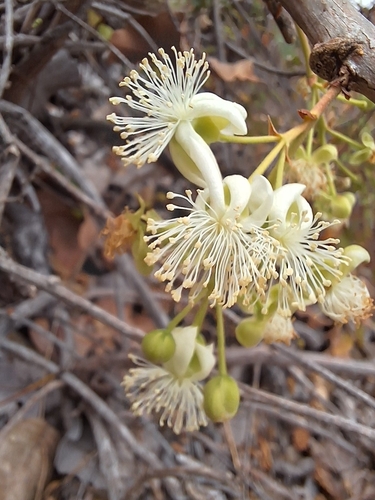
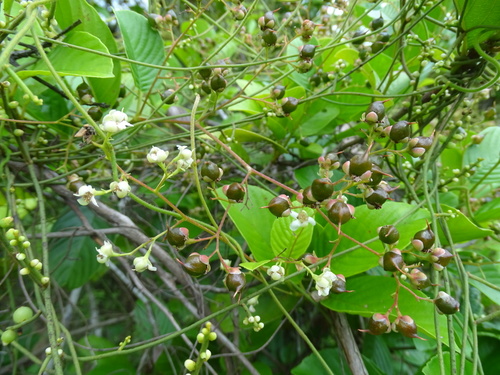
Tetracera sarmentosa (L.) Vahl is an evergreen woody vine or climber that can reach up to 20 meters long in China, and grows as a shrub in Bangladesh. Its young branchlets are rough and hairy, becoming hairless (glabrous) as they mature. The leaves are leathery, very rough, and measure 4–12 cm long by 2–5 cm wide. Mature leaves have glabrous lower (abaxial) surfaces, or only the leaf veins are covered in short soft hairs. Sepals and carpels of this species are glabrous. It has 3 white petals, each 4–5 mm long. Its fruits are orange follicles around 1 cm long, with a thin leathery pericarp that becomes slightly shiny when dry, and retains a persistent style. Each fruit holds one black seed that has a yellow, fringed aril surrounding the seed base. In China, Tetracera sarmentosa flowers from April to May; in Tripura, India, it flowers from April to June and produces fruits from July to August. Tetracera sarmentosa is native to tropical and temperate regions of Asia. It occurs in Peninsular Malaysia, Thailand, Vietnam, Laos, Myanmar, Sri Lanka, and Indonesia (Bengkulu, Sumatra). In China, it is found in southeast and south-central regions including Guangdong, Guangxi, Yunnan, and Hainan. In Bangladesh, it has been recorded in Chittagong, Chittagong Hill Tracts, Cox’s Bazar, and Satchari National Park in Habiganj district. In India, it occurs in Gondacherra and Chawmanu (Dhalai District), Chamtilla (North Tripura District, Tripura), and Biswanath district (Assam). Tetracera sarmentosa is one of the dominant plant taxa in secondary tropical evergreen seasonal lowland swamp angiosperm forests of Central Vietnam, growing in Hải Lăng District (Quảng Trị Province) and near Nha Trang (Khánh Hòa Province). In these Vietnamese locations, it grows on sandy soil at 10–50 m elevation near the seashore. In China, the species grows in sparse forests, thickets, and on barren hills. In Bangladesh's Satchari National Park, it grows on forest edges. In Sri Lanka, Tetracera sarmentosa is used as food for captive elephants. The Karbi and Munda peoples of Assam use cut stems of this plant to collect drinking water in dense forests where no other water source is available. The Tanchangya people of Bangladesh use root extract of Tetracera sarmentosa to treat rheumatism. Multiple leaf extracts of the species have been noted to have potential medical effects, but there is currently no evidence that the plant is effective against any disease.