About Tetracera nordtiana F.Muell.
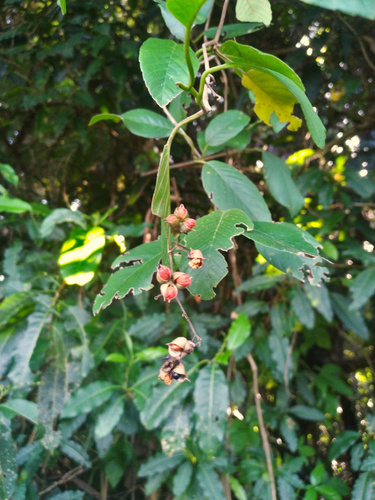
Tetracera nordtiana F.Muell. most commonly grows as a twining vine, and rarely as a scandent shrub. Its stem can reach up to 5 cm (2.0 in) in diameter, and its branches can grow up to 10 m (33 ft) long. Most parts of the plant, especially young growth, have varying levels of indumentum—they may be lightly to densely hairy, or even scabrid, with a sandpapery texture. Leaves grow up to 20 cm (7.9 in) long and 7 cm (2.8 in) wide, though they most commonly reach around 12 cm (4.7 in) long and 5 cm (2.0 in) wide. Leaves are generally elliptic to ovate in shape, with edges that are either toothed or entire, and have very distinct lateral veins. Inflorescences grow to around 20 cm (7.9 in) long, and hold an average of 60 fragrant flowers, each around 10 mm (0.39 in) in diameter. Each flower has 4 or 5 pale green sepals, 3 white petals, and between 120 and 150 stamens that measure about 5 mm (0.20 in) long. Flowers usually have 3 carpels, each containing 10 ovules. Mature fruiting carpels are around 8 mm (0.31 in) long with a pointed apex, and each holds one black seed that is surrounded by a red frilled aril. This species is native to Sulawesi, the Maluku Islands, the island of New Guinea, and the Australian state of Queensland. In Australia, it is found on some Torres Strait islands, in isolated pockets on Cape York Peninsula, and in a large population in coastal areas between roughly Rossville and Ingham. It grows in multiple forest types, including rainforest and swamp forest, at altitudes ranging from sea level to around 1,200 m (3,900 ft).