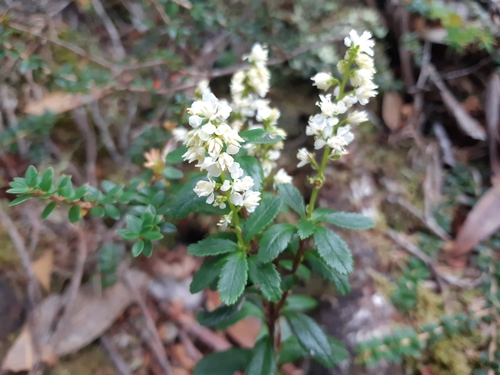
About Tetracarpaea tasmanica Hook.fil.
This description of Tetracarpaea tasmanica (also referenced as Tetracarpaea tasmannica) draws on information from multiple sources. Tetracarpaea tasmanica is a hairless, evergreen, erect, bushy shrub. Its height varies, most commonly ranging from 1.5 to 6 decimetres, though it may sometimes reach 1 metre in height and 7 decimetres in width. Its leaves are elliptic to oblanceolate, measuring roughly 25 millimetres long and 8 millimetres wide, borne on a petiole around 2 millimetres long. The leaf veins are prominent and terminate near the leaf margin. Leaf margins are serrate or crenate. A thick cuticle covers the epidermis on both leaf surfaces. The inflorescences are dense, erect, terminal racemes that grow up to 5 centimetres long. Flowers open in autumn. They are bisexual, actinomorphic, and measure 5 to 10 millimetres wide. The plant produces 4 sepals that remain on the plant until the fruit matures. It has 4 white, spatulate-shaped petals. The number of stamens is either 4 or 8. When there are 4 stamens, they align opposite the sepals, along the same radii as the sepals. The anthers are basifixed. The ovary is superior and made up of 4 carpels that are large relative to the other parts of the flower. The carpels are usually separate, but occasionally 2 or 3 are fused at their base, and rarely fused up to halfway up the carpels. The carpels are erect, stipitate, and have a suture along their ventral side. A placenta runs along each side of the suture, and bears 1 to 3 rows of numerous tiny ovules. Sources describe the ovules as having either one or two integuments. The ovary barely enlarges after flowering. The fruit is made up of 4 follicles joined at the base. The seeds are numerous and roughly ½ millimetre long.

