About Testudo marginata Schoepff, 1792
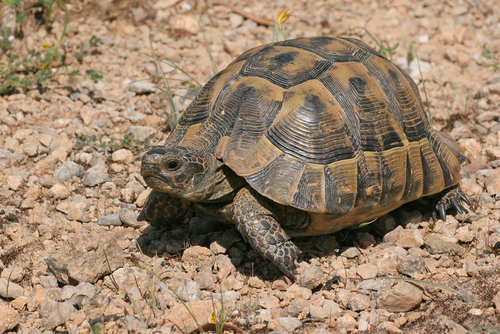
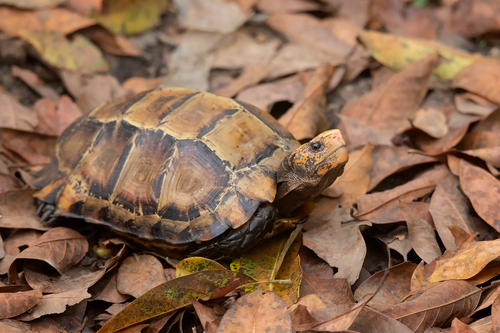
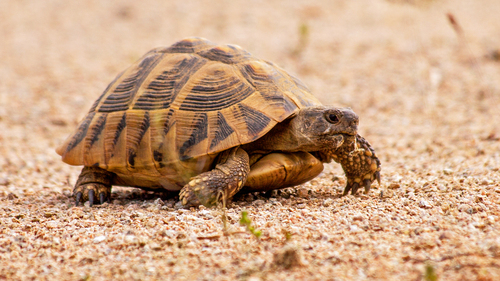
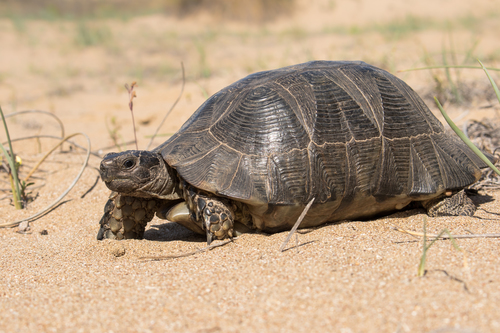
The marginated tortoise (Testudo marginata Schoepff, 1792) is the largest tortoise species native to Europe. Adults can reach a maximum weight of 5 kg (11 lb) and a maximum length of 35 cm (14 in). This species has an oblong shell that is notably thick around the midsection of the body. The posterior end of the shell forms a saw-like structure that flares outward like a bell. The carapace (upper shell) of adult specimens is almost entirely black with yellow markings. The plastron (ventral shell) is lighter in color and marked with paired triangular spots whose points face toward the tortoise's rear. The front surfaces of the limbs are covered in large scales. In old females, the rear underside flaps of the plastron are somewhat movable. The tail is distinguished by a lengthwise marking, and the carapace extending over the tail is undivided. Males have longer tails that are thicker at the base than those of females, and their undersides have a more prominent indentation. Males are also often larger than females. Females lay hard-shelled, spherical eggs in soil during May and June. The natural distribution of the marginated tortoise covers southern Greece, spanning from the Peloponnesus to Mount Olympus. It also occurs in isolated areas of the Balkans, Italy, and northeastern Sardinia. Compared to Hermann's tortoise, the marginated tortoise inhabits more mountainous regions, and can be found at elevations up to 1,600 m (5,200 ft). The black color of the carapace helps the species survive in this habitat by letting it absorb large amounts of heat quickly to maintain its body temperature. Early in the morning, marginated tortoises bask in sunlight to raise their body temperature, then go in search of food. After feeding, they return to their shelters to avoid the midday heat, and become active again in the late afternoon. Reproductive activity begins immediately after the tortoises wake from brumation, when males develop a mating instinct. Males actively follow females, circle them, bite their limbs, ram them, and attempt to mount them. During copulation, the male opens his mouth to display his red tongue and produces loud cries. These copulation cries have a sobbing quality with long, deep tones, which differs from the much higher, peeping calls made by Hermann's tortoise (T. hermanni) during mating. During mating, the female remains still, holds her head to the side, and looks up at the male's open mouth; the red tongue is thought to act as a visual signal. The female moves her head from side to side in the same rhythm as the male's cries. After mating, the female searches for a suitable location to lay her eggs. Once she finds an appropriate spot, she holds still, braces her front legs firmly against the ground, and digs a hole with her hind legs, alternating between the left and right. She starts by lightly scratching the ground, and eventually moves large piles of soil that she deposits beside the hole. The depth of the hole matches the length of her hind legs. If the ground is too hard to dig, she softens it by releasing water from her anal gland. Once the hole is complete, she begins laying eggs. Each egg is gently rolled into the hole. After the final egg is laid, she immediately starts refilling the hole with her hind legs, and finishes by stamping the opening closed with her feet to return the ground to its natural hardness. Larger females can lay eggs up to three times per summer, with around 15 eggs per clutch. Under natural conditions, the average incubation period for marginated tortoise eggs is around 100 days, which is relatively short compared to many other tortoise species. Many tropical tortoise species have incubation periods as long as 200 days. This shorter incubation period is an adaptation to the subtropical Mediterranean climate, where summers are not extended. When incubated artificially, the incubation period is noticeably shorter: at a constant temperature of 31.5 °C (88.7 °F), eggs will begin hatching after 60 days. Unlike bird eggs, the yolk and albumen of reptile eggs are not separated by a membrane. After a few days, heavy yolk components sink to the bottom of the egg, with the embryonal disk floating on top, surrounded by albumen. Because of this structure, tortoise eggs cannot be turned after the yolk settles, as this will damage or kill the developing embryo. Healthy development of the eggs can be seen with the naked eye. Freshly laid eggs are gray-white in color. Shortly after laying, a bright white spot forms on the top point of the egg, which gradually grows until the entire egg is bright white. When the embryo is fully developed inside the egg, the hatchling breaks the shell from the inside using its egg tooth, creates a small opening, and fills its lungs with air for the first time. After this, it pulls back into the egg and continues working on the shell with its beak until the shell opens completely. In natural conditions, hatchlings remain underground for their first two weeks, where they are protected from predators and can continue growing nourished by their yolk sac. Young marginated tortoises live cautious, secretive lives, normally staying in shaded areas. They avoid full direct sunlight because it puts them at high risk of overheating. Marginated tortoises grow very quickly when young. In an ideal habitat or with good captive care, they can gain between 100 and 500 g (3.5–17.6 oz) per year. This rapid growth continues through their youth, and after reaching 20 years of age, additional growth is minimal. Scientists' best estimates place their maximum lifespan between 100 and 140 years.