About Testudo hermanni Gmelin, 1789
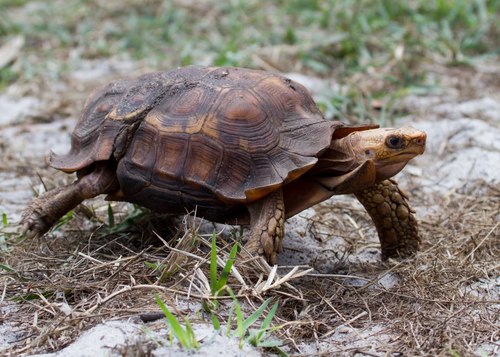
Hermann's tortoise (Testudo hermanni Gmelin, 1789) is a small to medium-sized tortoise native to southern Europe. Young tortoises and some adults have distinct black and yellow patterned carapaces; this bright patterning often fades with age, becoming less distinct and turning gray, straw, or yellow. They have slightly hooked upper jaws. Like all tortoises, they have no teeth, and instead rely on a strong, horny beak. Their scaly limbs are grayish to brown, with some yellow markings, and a horny spur sits at the tip of their tail. Adult males can be easily distinguished from females by their particularly long, thick tails and well-developed spurs. The eastern subspecies T. h. boettgeri is much larger than the western subspecies T. h. hermanni; T. h. boettgeri can reach up to 28 cm (11 in) in length, and a specimen of this size typically weighs 3–4 kg (6.6–8.8 lb). T. h. hermanni rarely grows larger than 18 cm (7.1 in), and some adult specimens are as small as 7 cm (2.8 in). Testudo hermanni ranges across southern Europe. The western subspecies T. h. hermanni is found in eastern Spain, southern France, the Balearic Islands, Corsica, Sardinia, Sicily, and southern and central Italy (Tuscany). The eastern subspecies T. h. boettgeri is found in Serbia, Kosovo, North Macedonia, Romania, Bulgaria, Albania, Turkey, and Greece, while the subspecies T. h. hercegovinensis lives along the coasts of Bosnia and Herzegovina, Croatia, and Montenegro. The oldest known fossil evidence of T. hermanni on Sardinia dates to the early Pleistocene from Monte Tuttavista, but molecular evidence suggests the current living populations of this species (and Emys orbicularis) on Sardinia were actually introduced in recent times. Hermann's tortoise has also been introduced to Cyprus. Each day, Hermann's tortoises leave their nightly shelters—usually hollows protected by thick bushes or hedges—early in the morning to bask in the sun and warm their bodies. After warming, they roam through the Mediterranean meadows of their habitat searching for food, and they select plants to eat using their sense of smell. In captivity, they eat a variety of wildflowers, but keepers must be careful when selecting available plants, because some flowers such as buttercups are toxic to this species. Plants like dandelion and kale contain high levels of oxalic acid, which can build up in the body over time and cause renal failure, so it is important to carefully monitor their diet and provide a varied selection of wildflower leaves. All commercially prepared pre-made food pellets are unsuitable for Hermann's tortoises; the pellets are addictive, and often lead to unnatural growth rates and cause tortoises to refuse natural foods. Some foods that tortoises will readily eat are still toxic to them, including legumes, tomatoes, and cabbage. Hermann's tortoises eat small amounts of fruit as supplementary nutrition, but this should only be offered occasionally. Around midday, the sun becomes too hot for the tortoises, so they return to their hiding places. They have a good sense of direction that allows them to navigate back to their shelters, and experiments confirm they also have a good sense of time, can detect the position of the sun, the Earth's magnetic lines, and use landmarks for orientation. In the late afternoon, they leave their shelters again and return to feeding. In late February, Hermann's tortoises emerge from hibernation; they spend the winter buried in a bed of dead leaves under bushes or old rotting wood. Immediately after emerging from their winter resting spot, Hermann's tortoises begin courtship and mating. Courtship is a rough process for the female: the male pursues, rams, and bites the female before mounting her. Rival males also show aggression toward each other during breeding season, which can lead to ramming contests. Between May and July, female Hermann's tortoises lay between two and 12 eggs in flask-shaped nests dug into soil, up to 10 cm (3.9 in) deep. Most females lay more than one clutch of eggs each breeding season. The pinkish-white eggs incubate for around 90 days. Like many reptiles, the incubation temperature determines the sex of hatchlings: at 26 °C, only male hatchlings are produced, while at 30 °C, all hatchlings will be female. Young Hermann's tortoises emerge just after the start of heavy autumn rains in early September, and spend the first four or five years of their lives within just a few metres of their nest. If the autumn rains do not arrive, or if nesting occurred late in the year, eggs will still hatch, but the young will stay underground and do not emerge until the following spring. Until they reach six to eight years old, when their hard shell becomes fully developed, young Hermann's tortoises are very vulnerable to predators, and may be preyed on by black rats, badgers, magpies, red foxes, wild boar, large snakes, European hedgehogs, and other animals. If they survive these early threats, the typical longevity of Hermann's tortoises is around 30 years, with one confirmed rare record of a 31.7 year lifespan. Compared to other tortoise species such as Testudo graeca, this species' longevity is likely underestimated, and many sources report Hermann's tortoises may live 90 years or more.