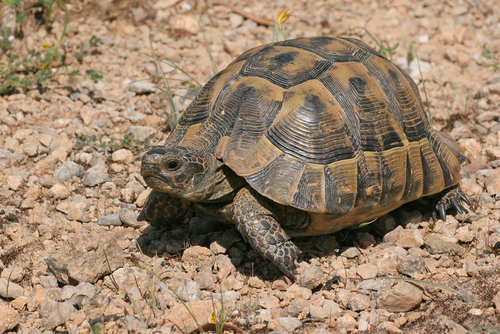
About Testudo graeca Linnaeus, 1758
Characteristics: The Ibera subspecies of Greek tortoise (Testudo graeca ibera) is often confused with Hermann's tortoise (Testudo hermanni), but notable differences allow these two species to be distinguished. Geographic range: The overall geographic distribution of Testudo graeca, the Greek tortoise, covers North Africa, Southern Europe, and Southwest Asia. It is commonly found along the Black Sea coast of the Caucasus, stretching from Anapa, Russia, to Sukhumi, Abkhazia, Georgia. Additional separate populations exist in parts of Georgia, Armenia, Iran, and Azerbaijan. Mating and reproduction: Reproductive behavior in Testudo graeca starts shortly after the tortoises emerge from hibernation. Males actively chase females, and perform courtship behaviors including circling, biting at the limbs, ramming, and attempting to mount. During copulation, males make squeaking sounds and display a red tongue by opening their mouths. Females typically stay still during copulation, bracing with their front legs and moving rhythmically in response to the male's actions. A single successful mating can produce multiple clutches of eggs. In captivity, males and females are often housed separately to prevent aggression. If multiple males are kept together, dominant behavior can develop, including attempts to mount other males. An unbalanced male-to-female ratio can lead to severe aggression and injury. Before oviposition, females become noticeably restless, and perform behaviors like sniffing and digging to find appropriate nesting sites. In the final days before laying eggs, females may show dominant behavior such as mock mounting and vocalizations. This behavior may help establish social dominance and ensure minimal disturbance while they lay eggs. The details of oviposition in this species are similar to those seen in related species like the marginated tortoise. Food: In captivity, Greek tortoises (Testudo graeca) commonly eat a range of leafy greens, and show a particular preference for dandelion leaves and similar vegetation. While they will readily eat lettuce, lettuce is generally not recommended as a staple food, because it does not contain the essential nutrients needed to support their long-term health and survival.