About Testacella maugei Férussac, 1819
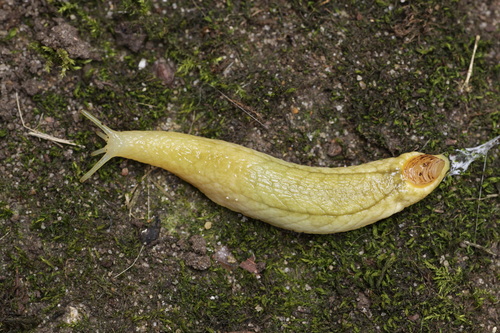
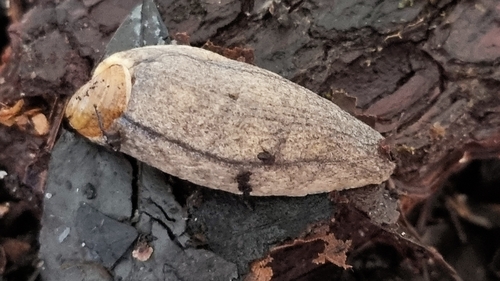
This species of slug, Testacella maugei Férussac, 1819, has brownish, darker coloration across its back and sides, marked with scattered brown and yellowish spots. Near the foot, the body is yellowish with a subtle greenish or orange hue. When crawling, its body has a somewhat conical shape: the anterior portion is wider than the posterior portion, and the posterior end is truncated. The lateral grooves originate about 5 mm apart from one another at the mantle, and these origins are not joined together. The slug's sole is yellowish. A shell rudiment is positioned on the posterior section of the dorsum. This rudiment is large, almost parallel-sided, with its apex pointing downward and the basal end of the aperture pointing upward. The shell is greenish or brownish, has two whorls, and features a keeled suture. The full adult animal ranges from 6 to 12 cm in length, while the shell measures 13–17 mm in length, 7–11 mm in width, and 3.5 mm in height. This species is distributed along the Atlantic coast of Morocco, the Azores, Madeira, the Canary Islands, Portugal, Spain, the Channel Islands, the Atlantic coast of France, and the British Isles including Britain and Ireland.