About Testacella haliotidea Draparnaud, 1801
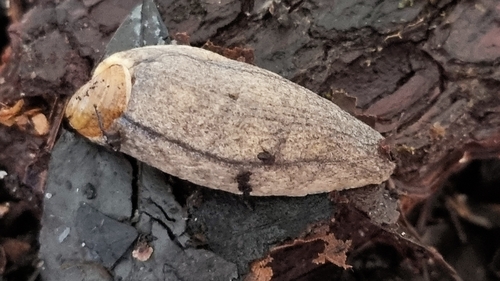
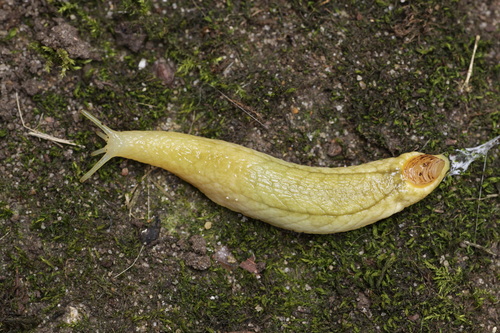
Like all other members of its family, this slug species has a small shell positioned toward the rear of its body. Its species epithet haliotidea was chosen because its shell resembles a miniature version of the shell of marine abalones, which belong to the family Haliotidae.
This is a large, very agile pale brown slug that can reach 12 cm in length. It has a small, ear-shaped external shell, less than 1 cm long, located at the tail end of its mantle. Below is a shell description modified from Tryon 1885: The shell is oval-auriform, depressed, and marked with rough striae. It has a thin epidermis that sheds easily. The apex is very small and short, and is not separated from the columellar margin. The aperture is rounded and usually wider toward the front; the columella and the outer margin of the aperture form a distinct angle where they meet. The shell interior is whitish and pearly, and the shell length ranges from 6 to 10 mm.
This species is common along the western Mediterranean, the European Atlantic coast, and across all of Great Britain except northern Scotland. It occurs across Europe, but its distribution across the continent is under-recorded. It has been recorded as an introduced species in Czechia. It also exists as an introduced species in southern Australia, New Zealand, and North America, where it is known as the earshell slug. Distribution data is incomplete for the United States (Oregon, Wisconsin) and Canada (British Columbia, Nova Scotia).
This species is most often seen in spring. It inhabits cultivated areas or disturbed ground, and lives mostly underground. It may sometimes be found under stones or within leaf litter.