About Tesseropora rosea (Krauss, 1848)
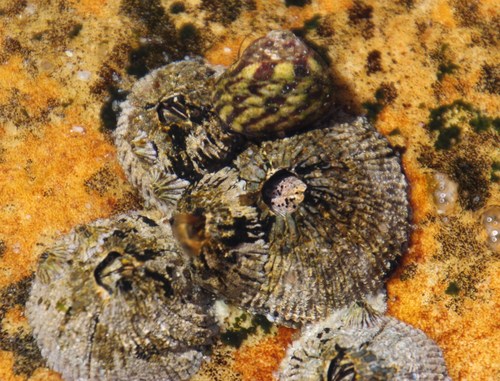
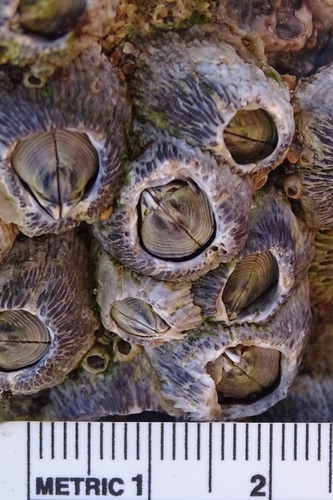
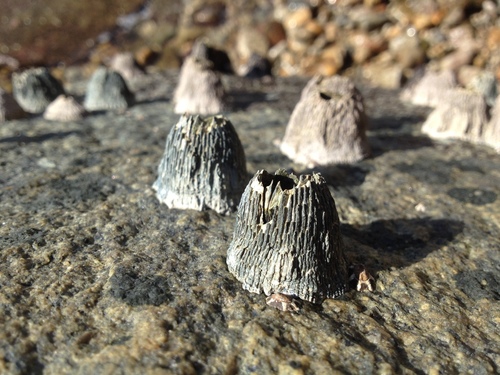
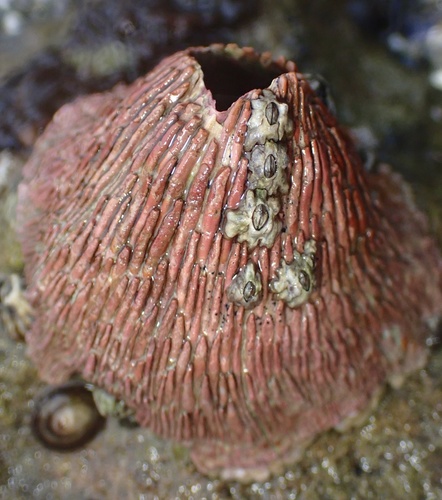
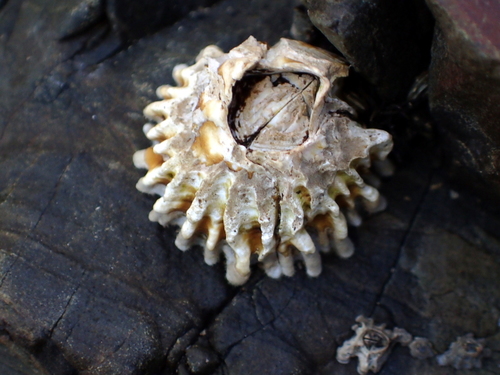
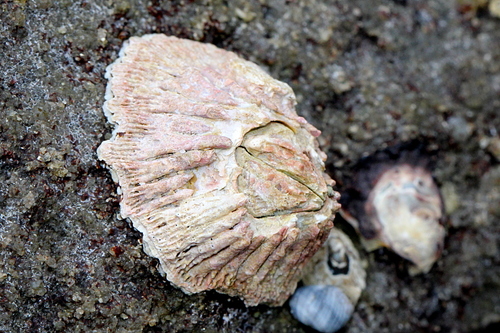
Rose barnacles (Tesseropora rosea) have a steep, conical shell with an outer wall made of four plates. The calcareous shell base is usually around 1.9 centimetres (0.75 in) in diameter, but can exceed 2.5 centimetres (0.98 in), and mature individuals typically grow 1.3 centimetres (0.51 in) tall. The central triangle-shaped portions of the shell plates are called parietes, and each pariete of this species has a single row of large, square pores or tubes. These pores are located inside the parietes, and can only be viewed from below when the barnacle is dead and detached from its substrate. Young rose barnacles have pale grey shells that turn pink as they age, and the entire shell is covered with purplish lines. The open top of the barnacle shell that connects to the external environment is called the orifice, which can be closed by the operculum. The operculum is made of two small shells called the tergum and the scutum, separated by a small linear opening, and functions as a lid for the barnacle. The orifice of rose barnacles is usually pentagonal, but it is often heavily eroded, and may appear quadrilateral or triangular as a result. The outer surfaces of the barnacle's opercular valves also commonly experience erosion. Both opercular valves are thick and solid, with visible ridges and furrows on their surfaces. The orifice measures between 2.3 and 7.8 mm (0.091 to 0.307 in) across. Rose barnacles live on exposed rocky shores, ranging from high tide levels down to a depth of 58 metres, and can tolerate strong wave activity. They attach themselves to stones and shells. In Australia, this species is common in Sydney Harbour, and abundant on the east coast of New South Wales and Queensland, between 19° and 38° south, as well as around Lord Howe Island and the isolated Kermadec Islands. On Australia's west coast, it is found in the Fremantle area and around Albany, where it may have been introduced via ballast water transfer. The species was originally described from Algoa Bay, South Africa. In Indonesia, it has been recorded from the islands of Ambon and Saparua.