About Terrapene triunguis (Agassiz, 1857)
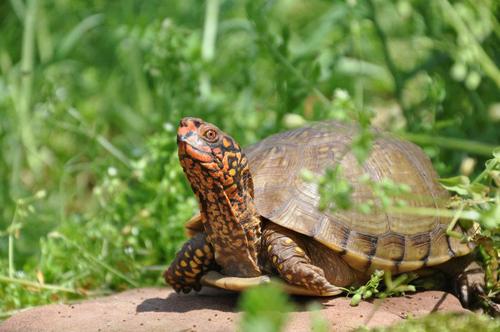
Three-toed box turtles get their common name from the number of toes on their back feet, though some individuals have four toes. Some researchers speculate that these four-toed individuals are actually hybrids between eastern box turtles and three-toed box turtles. Three-toed box turtles have a domed shell that reaches 5–7 inches (13–18 cm) in length. The highest point of their carapace (upper shell) is positioned further toward the rear than it is in any other related subspecies. Most three-toed box turtles lack strong dorsal and limb coloration; uniform olive green or tan color is most common in these areas, though dark blotches are also common in adults. Faint yellow dots or lines can sometimes be seen in the center of each large scute. Male three-toed box turtles often have yellow, red, or orange spots on their head and throat. Their bottom shell (plastron) is frequently a straw yellow color, and has far fewer dark markings than the plastrons of other subspecies. The three-toed box turtle’s range extends from eastern Texas in the west to the northern edge of the Florida Panhandle in the east. Its northernmost distribution reaches Missouri and Kansas, while its southernmost distribution reaches Louisiana. Where their range overlaps with other common box turtle subspecies, three-toed box turtles interbreed with those subspecies. This interbreeding occurs in the eastern Mississippi Valley, where three-toed box turtles are difficult to distinguish from eastern box turtles. Because they are popular in the pet trade, three-toed box turtles are sometimes found far outside of their native range. It remains unknown whether released captive individuals have any impact on native species in these areas. Three-toed box turtles are highly adaptable, and they may be the only box turtle species that can live happily in an indoor enclosure.