About Terpsiphone paradisi affinis (Blyth, 1846)
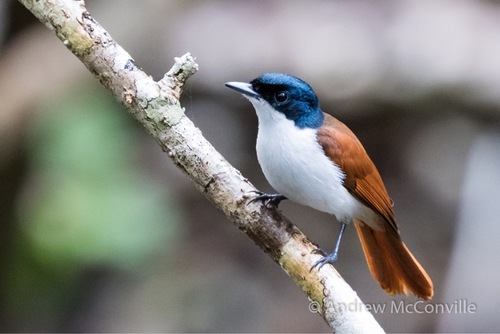
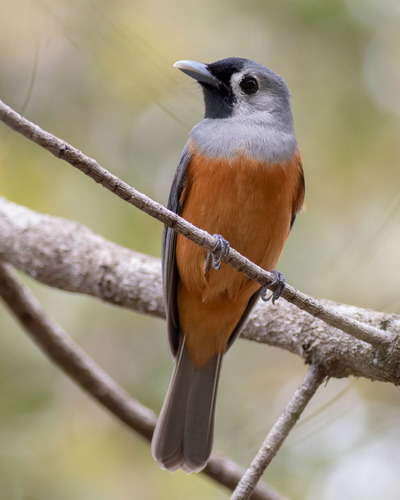
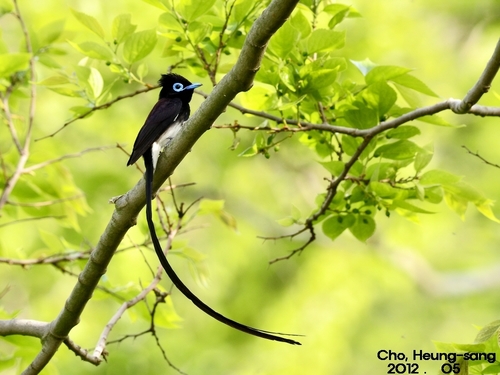
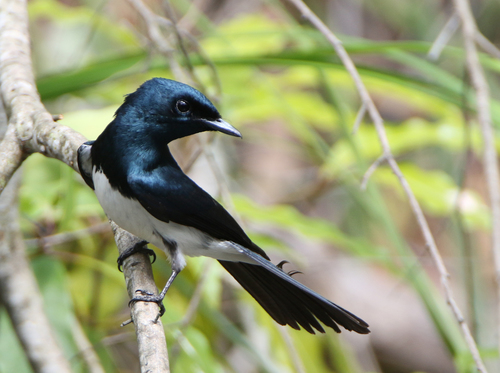
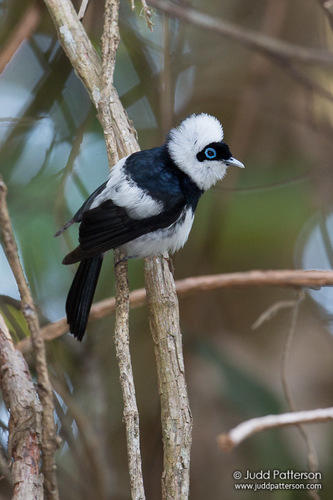
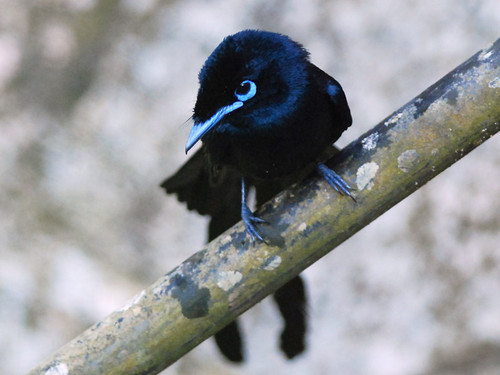
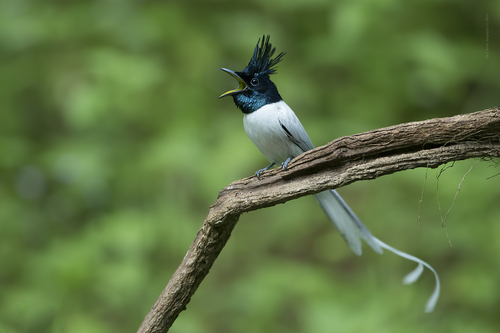
Scientific name: Terpsiphone paradisi affinis (Blyth, 1846). Adult Indian paradise flycatchers measure 19–22 cm (7.5–8.7 in) in length. They have glossy black heads with a black crown and crest, a round, sturdy black bill, and black eyes. Females have rufous backs, with greyish throats and underparts; their wings are 86–92 mm (3.4–3.6 in) long. Young males closely resemble females, but have a black throat and blue-ringed eyes. As they mature into adults, they develop tail feathers up to 24 cm (9.4 in) long, with two central tail feathers growing into drooping streamers that reach 30 cm (12 in) in length. Young males are rufous with short tails, and acquire their long tails in their second or third year. Adult males are either predominantly bright rufous above, or predominantly white. Some specimens show a degree of intermediacy between the rufous and white plumage types. Long-tailed rufous birds generally have no shaft streaks on their wing and tail feathers, while white birds have black shaft streaks, and sometimes black edges on their wing and tail feathers. In the early 1960s, before Blyth's and Amur paradise flycatchers were recognized as separate species, 680 long-tailed males held in the collections of the British Museum of Natural History, Chicago Natural History Museum, Peabody Museum, Carnegie Museum, American Museum of Natural History, United States National Museum, and Royal Ontario Museum were examined. The specimens came from almost the entire range of the species, though some areas were poorly represented. The relative frequency of rufous and white plumage types varies by geographic location. Rufous birds are rare in the extreme southeastern portion of the species' range. Throughout the Indian region and, to a lesser extent, in China, asymmetrically patterned intermediate plumage specimens occur. Intermediates are rare or absent across the rest of the species' range. A breakdown of collected long-tailed male plumage patterns and their collection locations follows: predominantly rufous with some white in wings and tail, collected in Turkestan, Kashmir, northern India, Punjab, Maharashtra, Sikkim, and Sri Lanka; predominantly rufous with some white in wings, collected in Iran, Afghanistan, Baluchistan, Punjab, Kashmir, northern and central India, Rajasthan, Maharashtra, Bihar, and Nepal; predominantly rufous with some white in tail, collected in Punjab, northern and central India, Kolkata, Sri Lanka, and the Upper Yangtze Valley in China; predominantly white with some rufous in tail and wings, collected in Kashmir, Maharashtra, Sichuan, and North China; predominantly white with some rufous in tail, collected in Maharashtra and Fuzhou, China; predominantly white with a partly rufous back, collected in Punjab and Chennai; individuals moulting from rufous into white plumage, collected in North Bihar. Three possible interpretations of this plumage variation have been proposed: males may be polymorphic for rufous and white plumage colour; rufous birds may be sub-adults; and there may even be two sympatric species that can only be distinguished by the appearance of males. The Indian paradise flycatcher is a migratory bird that spends the winter in tropical Asia. In southern India and Sri Lanka, especially the highlands and western parts of Sri Lanka, both locally breeding populations and visiting migrant populations are present in winter. The breeding season of the Indian paradise flycatcher runs from May to July. This species is socially monogamous, with both males and females participating in nest-building, incubation, brooding, and feeding of young. The incubation period lasts 14 to 16 days, and the nestling period lasts 9 to 12 days. Nests are sometimes built near a breeding pair of drongos, which deter predators. The female lays up to four eggs in a neat cup-shaped nest built from twigs and spider webs on the end of a low branch. There is a discrepancy in the original text, which also notes that chicks hatch in about 21 to 23 days. One recorded case of interspecific feeding has been observed, where Indian white-eyes fed paradise flycatcher chicks.