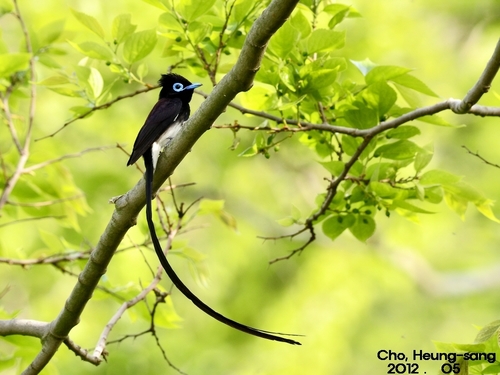
About Terpsiphone atrocaudata (Eyton, 1839)
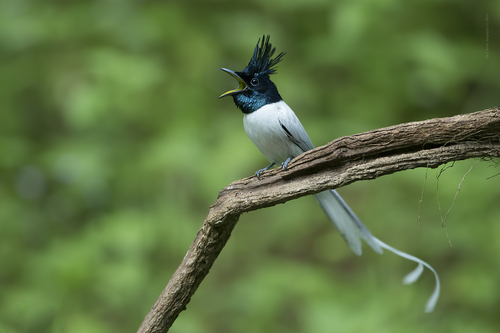
The black paradise flycatcher, Terpsiphone atrocaudata, is similar in appearance to the Amur paradise flycatcher and Blyth's paradise flycatcher, but is slightly smaller. Mature males have a black hood with a purplish-blue gloss that shades into blackish-grey on the chest. Their underparts are off-white to white, while the mantle, back, wings and rump are plain dark chestnut. Their tails have extremely long black central feathers; these feathers are shorter in immature males. Unlike the Asian paradise flycatcher, this species has no white morph. Females resemble males, but are duller and have darker brown coloration in their chestnut areas. This bird has black legs and feet, a large black eye with a blue eye-ring, and a short blue bill. In Japanese, the species' song is transcribed as tsuki-hi-hoshi, hoi-hoi-hoi, which translates to Moon-Sun-Stars. This translation gives the bird its Japanese name サンコウチョウ (三光鳥) sankōchō, which literally means bird of three lights (moon, sun, star), from san meaning three, kō meaning lights, and chō meaning bird. Gotjawal Forest, a forest growing on rocky volcanic AA lava in Jeju-do, South Korea, is one of the important breeding sites for the black paradise flycatcher. A recent survey found a steep decline in part of the species' Japanese breeding population; this decline is presumably caused by forest loss and degradation in the species' winter range.