About Terminalia catappa L.
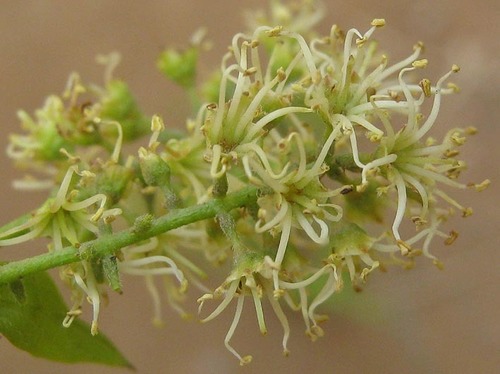
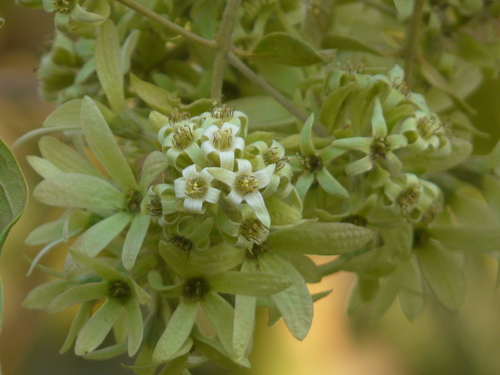
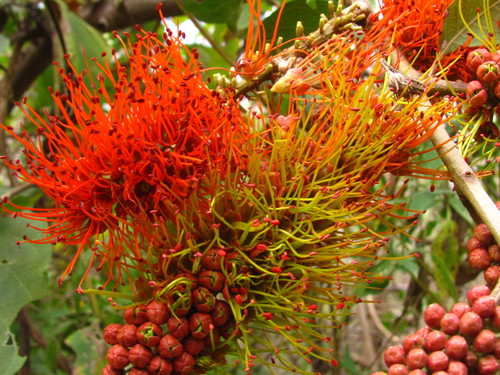
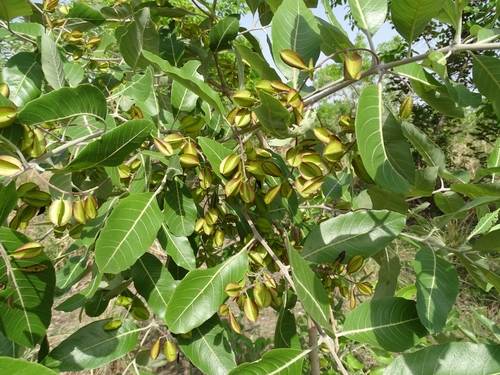
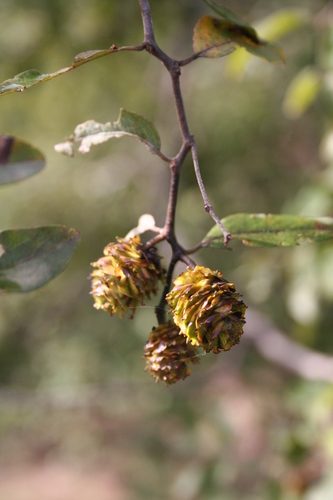
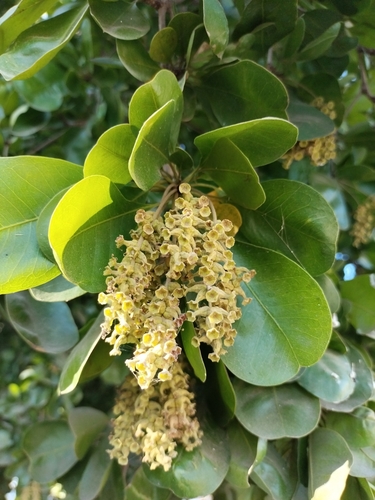
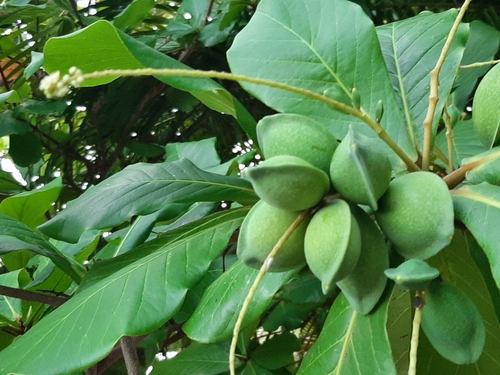
Terminalia catappa L. is a tree that can reach 35 metres (115 feet) in height, with an upright, symmetrical crown and horizontal branches. As the tree ages, its crown becomes flatter and develops a spreading, vase shape. Its branches are characteristically arranged in distinct tiers. The leaves are large and ovoid, measuring 15–25 cm (6–9+3⁄4 in) long and 10–14 cm (4–5+1⁄2 in) broad, with a glossy, leathery dark green surface similar to paper. The leaves are shed during the dry season, and before falling they turn pinkish-reddish or yellow-brown due to pigments including violaxanthin, lutein, and zeaxanthin. This species is monoecious, meaning separate small male and female flowers grow on the same individual tree. Both types of flowers are borne on axillary or terminal spikes, are 1 cm (3⁄8 in) in diameter, range in color from white to greenish, are inconspicuous, and lack petals. Pollen grains of Terminalia catappa L. measure approximately 30 microns across. The fruit is a drupe 5–7 cm (2–2+3⁄4 in) long and 3–5.5 cm (1+1⁄8–2+1⁄8 in) broad that contains a single seed. It is green when young, then turns yellow, and finally becomes red when fully ripe. The whole fruit has a light, corky texture that allows it to be dispersed by water, and it can also be spread by bats that eat the fruit. When the seed germinates, it produces the largest pair of foliar (leafy) cotyledons of any known plant, reaching up to 8.5 cm (3.3 in) wide and up to 3.5 cm (1.4 in) long. The native range of Terminalia catappa L. is uncertain, because the species has been spread widely by humans. It has been long naturalized across a broad belt extending from Africa through southeast Asia and Micronesia to northern Australia, New Guinea, and the Indian subcontinent. More recently, it has been introduced to parts of the Americas. Until the mid-20th century, the tree was used extensively for urban landscaping in Brazil, as it is an unusual tropical deciduous tree whose fallen leaves gave streets a "European" flair. This landscaping practice has now been discontinued, and these trees (called "amendoeiras") are being replaced by native evergreen trees. Terminalia catappa L. is widely cultivated as an ornamental tree across tropical regions of the world, planted for the deep shade provided by its large leaves. The fruit is edible, with a slightly acidic taste. When ripe, the seeds are edible raw or cooked, which gives the species its common "almond" names, though the seeds are small and difficult to extract. The wood is red, solid, and has high water resistance; it has been used in Polynesia to make canoes. In the Tamil language, this almond is called nattuvadumai. The leaves of Terminalia catappa L. contain multiple flavonoids (such as kaempferol and quercetin), several tannins (such as punicalin, punicalagin, and tercatin), saponins, and phytosterols. Because of this chemical content, the leaves and bark are used in various herbal medicines for different purposes. For example, fallen leaves are used as an herbal remedy for liver diseases in Taiwan. In Suriname, herbal tea made from the leaves is prescribed to treat dysentery and diarrhea. The leaves may contain compounds that could help prevent cancer (though no anticarcinogenic properties have been demonstrated), as well as antioxidants and anticlastogenic characteristics. Extracts of Terminalia catappa L. have shown activity against both chloroquine (CQ)-resistant (FcB1) and CQ-sensitive (HB3) strains of Plasmodium falciparum. Storing Terminalia catappa L. leaves in an aquarium can lower the water's pH and heavy metal content. Fish breeders have used this method for many years, and the leaves are active against some parasites and bacterial pathogens. They are also thought to help prevent fungus from growing on fish eggs. While this use of catappa leaves is common in hobbyist fishkeeping, it is not used in commercial aquaculture.