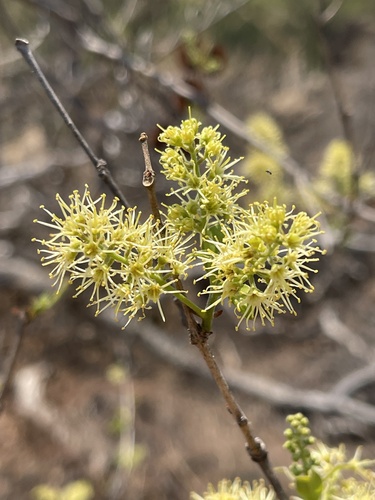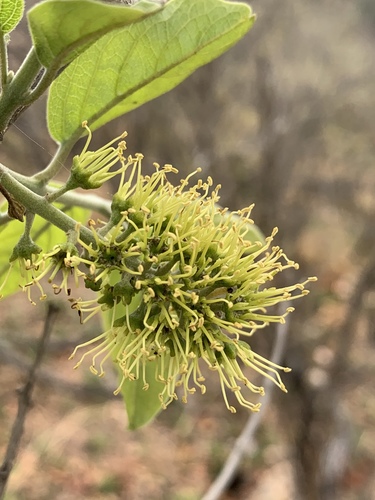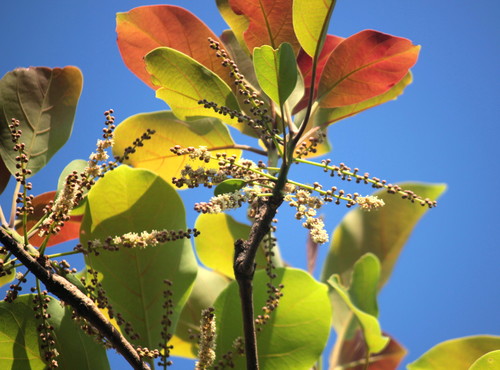
About Terminalia bellirica (Gaertn.) Roxb.
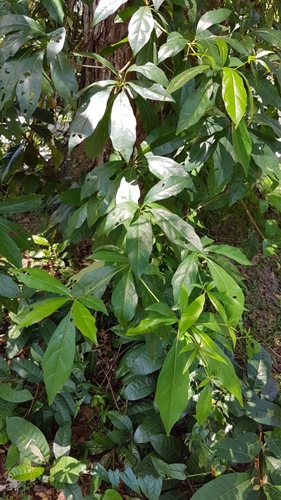
Terminalia bellirica (Gaertn.) Roxb., commonly called bahera, beleric, or bastard myrobalan, is a large deciduous tree belonging to the family Combretaceae. It grows commonly on plains and lower hills across South and Southeast Asia, and is also cultivated as an avenue tree in this region. Its basionym is Myrobalanus bellirica Gaertn., published in Fruct. Sem. Pl. 2: 90, t. 97 in 1791. When William Roxburgh transferred this species to the Terminalia genus, he spelled the specific epithet as "bellerica", creating the name "T. bellerica (Gaertn.) Roxb.". This spelling error is now widely used and has caused taxonomic confusion, so the correct scientific name remains Terminalia bellirica (Gaertn.) Roxb. In traditional Indian Ayurvedic medicine, this species is known as bibhitaki, called behada or bhenda in Marathi. Its fruit is a key ingredient in triphala, a popular Indian herbal rasayana treatment. It is called bibhītaka in Sanskrit. In India, the town of Neemuch in the Malwa region of Madhya Pradesh is a major trading center for both skinless baheda and whole fruits of T. bellirica, and fruits of the species are widely harvested from the wild in the Malwa region of Madhya Pradesh. According to Dymock, Warden, and Hooper's 1890 Pharmacographia Indica: This tree, called Bibhita and Bibhitaka (meaning fearless) in Sanskrit, is avoided by Hindus in Northern India, who will not sit in its shade because it is believed to be inhabited by demons. Two varieties of the species (referred to as T. belerica in the source) are found in India: one bears nearly globular fruit 1/2 to 3/4 inch in diameter, while the other has larger, ovate fruit. Ayurvedic physicians consider the pulp of the fruit (called beleric myrobalan) to be astringent and laxative, and it is prescribed with salt and long pepper for throat and chest infections. As one of the three fruits in triphala, alongside emblic myrobalan and chebulic myrobalan, it is used to treat a wide range of diseases. The kernel is sometimes applied externally to inflamed areas of the body. Due to its medicinal properties, the tree has the Sanskrit synonym Anila-ghnaka, meaning "wind-killing". According to the Nighantus, the kernels are narcotic. The ancient Ayurvedic text Charaka Samhita notes that bibhitaki fruits have qualities that alleviate disease, and grant longevity, intellectual ability, and strength. Several rasayana preparations described in the Charaka Samhita include bibhitaki. The Fourth Amalaka Rasaayan, which lists bibhitaki as one of its component fruits, is described as follows: "By this treatment, the sages regained youthfulness and attained disease-free life of many hundred years, and endowed with the strength of physique, intellect and senses, practiced penance with utmost devotion."