About Teratoscincus scincus (Schlegel, 1858)
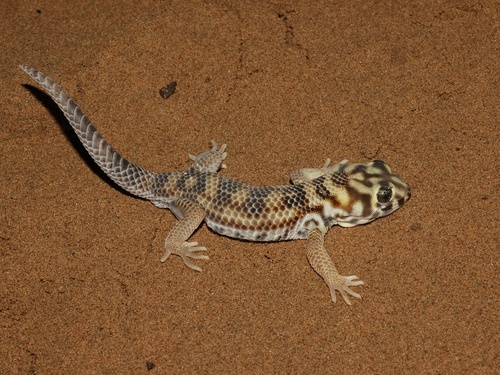
Teratoscincus scincus is a large gecko that reaches a total length of roughly 16 cm (6.3 inches), including its tail. It has a broad head, large eyes, long robust limbs, and a short tail. Unlike many climbing geckos, it does not have expanded toe-pads; instead, its digits have fringes of comb-like scales adapted for moving across loose sandy terrain. Its head is covered in particularly small scales, while body scales are larger, and tail scales are especially large. Adult individuals are buff or yellowish-brown, marked with broken black stripes or irregular dark spots, with white flanks and bellies. Newly hatched juveniles have more vivid colouration, being bright yellow with dark crossbands. The geographic range of T. scincus covers the Middle East, Central Asia, and the westernmost part of East Asia. Its distribution spans central and western Iran, western Afghanistan, northern Baluchistan and Pakistan, the area east of the Caspian Sea, western China, and the Arabian Peninsula, where populations are found in Kuwait, Qatar, United Arab Emirates, Oman. It also occurs in Kazakhstan, Turkmenistan, Uzbekistan and Tajikistan. The species' type locality is the Ili River Valley, which lies in China and Kazakhstan. Originally, two subspecies were recognized: T. s. rustamowi from the Ferganskaya Valley in Uzbekistan, and the nominotypical T. s. scincus found across the rest of the range. The former T. s. rustamowi has since been elevated to full species status as Teratoscincus rustamowi. The typical habitat of T. scincus is deserts, semi-arid areas, sand dunes, and gravel plains. T. scincus is a nocturnal species that digs deep burrows, where it stays cool and hydrated during the day. It has a varied diet that includes insects and other lizards. When attacked while on the surface, it can produce a yelping vocalisation or a defensive hiss, and it lashes its tail to rub the large tail scales together. If provoked, it takes on a threatening display: it stands on tiptoe, arches its back, expands its throat, opens its mouth wide, and lashes its tail. Further provocation may cause it to squeak as it rushes forward to bite its attacker. It is also capable of autotomising, shedding its tail, as an additional defensive strategy.