About Teratohyla pulverata (Peters, 1873)
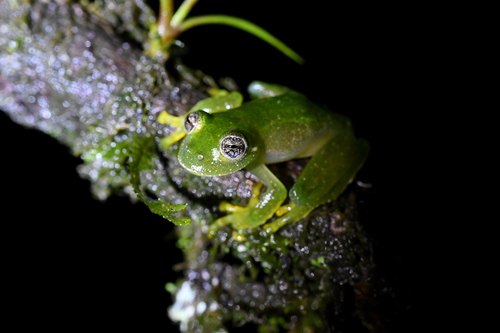
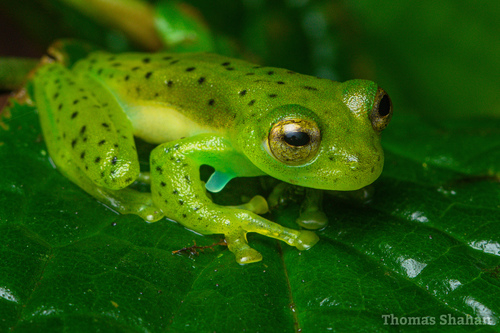
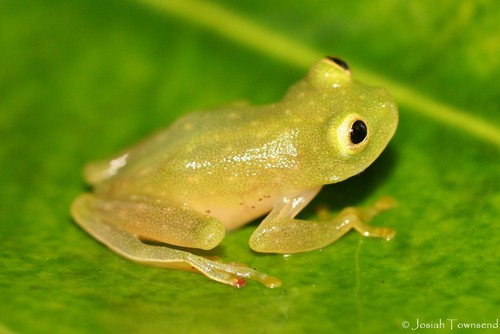
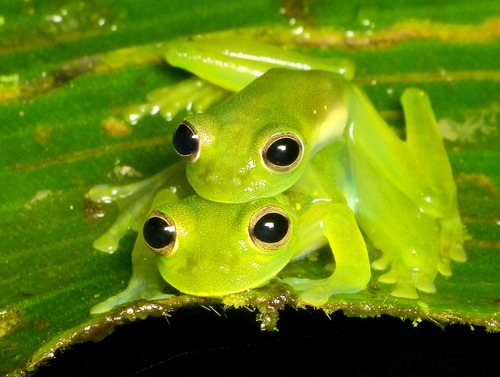
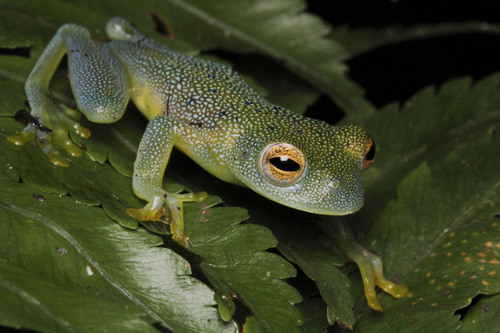
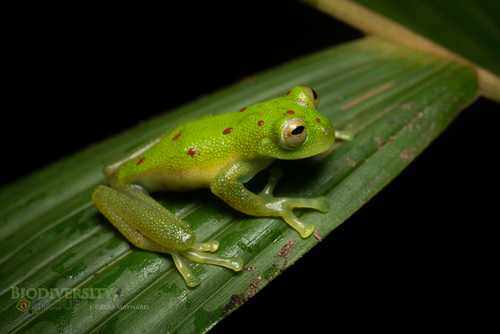
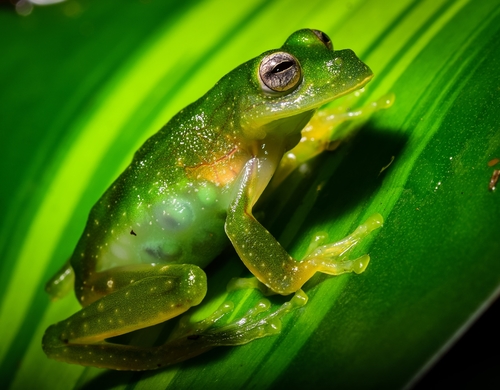
Teratohyla pulverata is a small glass frog. Males of this species lack humeral spines, and it has a lobed bulbous liver, which has historically placed it in the genus Cochranella. Adult males measure 22–24.5 mm in snout-vent length (from snout to vent), while adult females are larger, measuring 25.3–28.3 mm in snout-vent length. When viewed from above, the snout is rounded, but it has a distinctly sloped profile when viewed from the side. The translucent tympanum is visible but not large, measuring about one-fifth to one-fourth of the eye's diameter; most of the tympanic annulus is not hidden, only its dorsal margin is covered by the supratympanic fold. The dorsal surface of this frog is green, heavily scattered with small white spots – this pattern gives the species its scientific name, which means "the powdered one". The back has a rough shagreen-like texture, particularly in males, which are covered in tiny spicules. The belly is transparent and has a grained texture, which allows the green bones and some internal organs to be observed in a living individual. This visibility is further enabled by the fact that this species' parietal (outer) peritoneum is also completely translucent, while the inner peritonea covering the liver and gastrointestinal tract are white. The iris is greyish-white with tiny yellow dots and a network of thin, dark-grey lines; a thin cream-yellow ring surrounds the pupil. Melanophores are abundant on the dorsal surface of the fourth finger, but absent on the first three fingers. Preserved specimens are usually cream-colored to light lavender on their dorsal surface, with the original white spots remaining white or becoming transparent. The dentigerous process of the vomer carries two to four teeth. Males have a type-I nuptial pad, and the prepollex is concealed. The toes and most fingers are webbed, but webbing between the first two fingers (which are of equal length) is either absent or vestigial. The webbing formula for the outer fingers is II (1+–1 1/3) – (2 4/5–3−) III (1 1/3–1 2/3) – (1+–2−) IV; for the toes, it is I (1−–1) – (1 2/3–2−) II (1−–1) – (1 3/4–2−) III (1–1+) – (1 2/3–2+) IV (2−–2+) – (1−–1+) V. The adhesive discs at the tips of the fingers and toes are small; the disc on the third finger is about the size of the eardrum. This species has no tubercles on the thighs; tubercular folds are present on the metacarpus, ulna, metatarsus, and tarsus, creating a wavy outline along the limbs. Tadpoles have a tooth row formula of 2/3, with the A2 tooth row broadly separated in the center. Its natural habitats are tropical moist lowland forests and rivers, and it is mostly found in riparian vegetation. In the northern part of its range, extending approximately south to the Isthmus of Panama, it occurs on the Atlantic side of the American Cordillera; on the Pacific side, it is found from Costa Rica southwards. It occurs at elevations up to 960 meters above sea level in the northern parts of its range, but apparently only up to 300 meters above sea level in its southern range. Males call from the upper sides of leaves, usually producing three notes each about 0.05 seconds in duration with a dominant frequency of 5,600–6,200 Hz, with notes separated by pauses of 0.5 to 0.8 seconds. It is unknown if and how males physically fight for access to females. Clutches of eggs are deposited on the upper sides of leaves above small streams; after hatching, tadpoles drop into the water below. Parents do not guard the eggs or provide any other care for their offspring. This species is moderately common in Honduras, uncommon in Costa Rica, and only rarely found in Colombia. It is able to persist in small forest fragments, so the IUCN does not consider it threatened.