About Terathopius ecaudatus (Daudin, 1800)
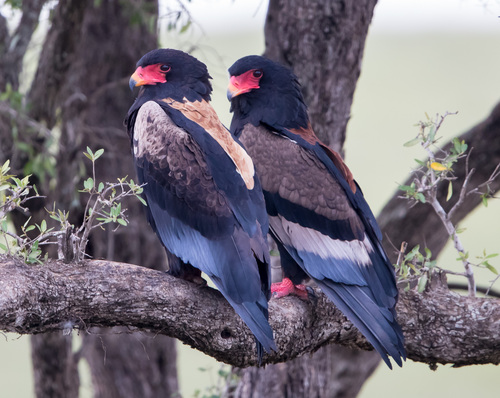
The bateleur (Terathopius ecaudatus, first described by Daudin in 1800) has unique morphology and plumage, sharing some anatomical traits with both snake eagles and vultures. It has a thick neck, a very large, noticeably cowled head, and a proportionately short bill covered by a very large cere. The cowl, which is also present but less pronounced in snake eagles, gives the head its distinct shape. Other features of perched adult bateleurs are unusually stumpy, including short legs and an exceptionally short tail that is likely proportionally shorter than that of any other raptor. When perched, bateleurs hold an extremely upright posture that makes them appear quite tall on the ground despite their short legs. Even when perched, their exceptionally large wings, which have around 25 secondary feathers, more than most other raptors, dominate the body outline.
Adult bateleurs typically have chestnut coloration on the mantle, back, rump, tail, and undertail coverts. Adult males are predominantly black with grey shoulders, which appear white-edged after fresh moulting. Adult females differ from males: their greater coverts are grey-brown rather than black, and their secondaries are grey with black tips rather than entirely black. Up to 7% of adults belong to a "cream morph" that retains a chestnut tail, but has all other normally chestnut areas replaced by cream to pale brown colouring; this morph is reported to be slightly more common in drier areas.
The bare body parts of adult bateleurs are very noticeable: the cere, bare facial skin, and feet are all bright red, though they can temporarily fade to pink, pale pink, or yellowish in some conditions, such as when perching in shade or bathing. Bare parts flush to their brightest red when the bateleur is excited. The bill is black with a yellow centre and red base, and the eyes are dark brown.
Juvenile bateleurs are very distinct from adults. They have longer tails than mature birds, and are almost entirely brown, with dull rufous to creamy edging on some feathers. The juvenile's head is paler and tawnier than the rest of its body, eyes are brown, the cere is a distinct greenish-blue, and the feet are whitish. Immature bateleurs still look very similar to juveniles until they reach 2 to 3 years of age. By their fourth year, they become more sooty-brown, and sexual dimorphism is already visible via more extensive dark wing markings in males. In their fifth year, plumage begins to show the first hints of chestnut, and grey colour starts to appear on the back and shoulders. Between 3 and 5 years of age, the cere and feet turn yellow, then dull-pink. By the sixth and seventh years, subadult plumage darkens to black, and the chestnut areas grow larger. Shoulders become fully grey by the eighth year, which is the typical age of maturity. For young bateleurs, the cere and facial skin start as a distinct pale grey-blue to green-blue, and feet are greenish-white to greyish-white. At 4 to 5 years old, the cere, facial skin, and feet turn yellow, then pink, before finally turning red. Juvenile eyes are similar in hue to adult eyes but slightly lighter honey-brown, and juvenile bills are mainly pale grey-blue.
In flight, the bateleur is a large raptor with disproportionately elongated, rather narrow, slightly bow-shaped wings that are pinched at the base, broad across the secondaries, and regularly narrow, pointed, and upturned at the tips. The large head catches the eye after the wings, and is proportionally slightly larger than that of the bateleur's close relatives, the snake eagles. The adult's tail is so short that the feet extend past the tail tip, giving the impression the raptor almost has no tail. In contrast, the juvenile's feet end about 5 cm (2.0 in) short of the tail tip; as the bateleur matures, moulting produces a progressively shorter tail, and the feet extend past the tail tip by around the fifth year. The adult bateleur's wingspan is an unusual 2.9 times greater than its total body length.
In flight, adult males are mostly black above with a chestnut back and tail and grey forewings; below, the body is black, contrasting with the chestnut tail, white wing linings, and black flight feathers (with the exception of grey-based primaries). Adult females have similar overall plumage to males, but differ in having black-tipped grey secondaries on the upper side, and more extensive white on the underwings, with black limited to the wingtips and trailing edges. Juvenile bateleurs in flight have broader wings and a notably longer tail, with largely uniform brown colouration including on the greater coverts, and paler feathers mainly concentrated on the head and flight feathers.
The bateleur, especially in adult plumage, is widely considered one of the most distinctive raptors in the world. Perched or flying adults and older immatures are quite unmistakable. Bateleurs can be easily told apart from the generally smaller-bodied, smaller-winged augur buzzards (Buteo augur) and jackal buzzards (Buteo rufofuscus) by inexperienced observers, as these buzzards do not match the bateleur in morphology, proportions, or flight behaviour. Still, both buzzard species are sometimes mistaken for bateleurs because they also combine black, white, and chestnut colouration, though the pattern of this colouration is completely different. Many supposed bateleur sightings in areas where the species is no longer present are almost certainly misidentified jackal buzzards. Juvenile and immature bateleurs up to 2 to 3 years old have just as distinctive body shape, but can be confused with certain snake eagles due to their similar large head, brown plumage, and whitish legs. The brown snake eagle is the most similar to juvenile bateleurs, but it has yellow eyes, longer legs, and much broader, shorter, differently shaped wings whose tips reach the brown snake eagle's banded tail. Even the black-chested snake eagle and the smaller Beaudouin's snake eagle (Circaetus beaudouinii) are sometimes considered potentially confused with juvenile bateleurs, but both species are uniformly darker brown on the underside and head, much paler on the back, and have a contrasting whitish cream underside that is very different from the bateleur.
The bateleur has a very large range centered mainly on sub-Saharan Africa. In West Africa, it occurs from southern Mauritania through Senegal, The Gambia, Guinea-Bissau, Guinea, northern Sierra Leone, Ivory Coast, most of Ghana, western Burkina Faso, most of Togo and Benin, and northern and central Nigeria. It is possibly extinct in Mauritania, has a restricted range in Guinea (mainly to Kiang West) and Liberia, but remains locally common in suitable habitat elsewhere in the region. Outside of Africa, a small rare population is thought to persist in extreme southwestern Saudi Arabia and western Yemen. In central and east Africa, the bateleur occurs in northern Cameroon, southern Niger, southern Chad, southern Sudan, South Sudan, northern Central African Republic, Eritrea, Ethiopia, Djibouti, western Somalia, northern, eastern and southern Democratic Republic of the Congo, and most of Uganda, Kenya, and Tanzania. In Southern Africa, the bateleur is widespread across suitable habitat, occurring throughout nearly all of Angola, Zambia, Zimbabwe, Malawi, and Mozambique. It also occurs in all but the southernmost part of Botswana, and still lives in northern and eastern Namibia and northwestern South Africa. In South Africa, its range has contracted considerably: it once ranged as far south as Cape Province, and now is almost exclusively found in protected areas north of the Orange River, with the exception of part of Kruger National Park. The species is possibly extirpated from Eswatini in southern Africa.
The bateleur is a common to fairly common resident or nomadic bird of partially open savanna and woodland in sub-Saharan Africa. During breeding, it requires closed-canopy savannah-woodland habitats, including Acacia savanna, mopane, and miombo woodlands. It can also adapt to thornveld and various fairly shrubby areas. It rarely occurs in heavily forested or mountainous habitats. While it can forage extensively in largely treeless habitats such as open savanna, it is just as rare in pure desert with no woody growth as it is in tropical rainforests. Bateleurs are seldom found near large wetlands, but regularly occur around watering holes. Though they often occupy fairly dry savanna habitats, they are reported absent from areas in Kenya with annual rainfall under 250 mm (9.8 in), likely because low rainfall limits growth of the leafy trees they need for nesting. In Ethiopia, it tends to associate with well-wooded areas.
Habitat use has been most studied in southern Africa. The bateleur is mostly commonly found in broad-leaved woodland in the Okavango Delta, Botswana. In Namibia, it is often found over tall woodland near drainage lines, over ephemeral rivers in northeastern Namibia, and within the arid Etosha National Park. In Zambia, it occurs in a variety of habitats from woodlands to open plains, but avoids the most densely wooded areas. In Malawi, it is often associated with forest-savanna mosaics, but is sometimes regularly seen over cultivated areas and may even fly over large cities. In contrast, it is said to avoid areas with dense human populations in Mozambique. The species can occur from sea level up to 4,500 m (14,800 ft), but is not normally a mountain-dwelling species and mainly occurs below 3,000 m (9,800 ft). This matches observations from Zimbabwe, where the bateleur is relatively common but largely avoids the country's extensive hilly and rugged areas.