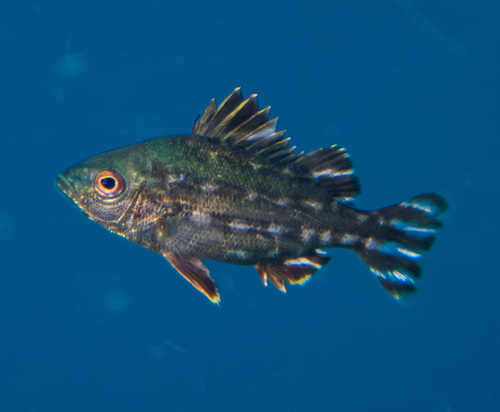
About Terapon theraps Cuvier, 1829
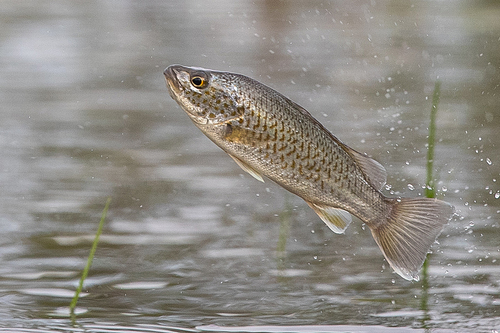
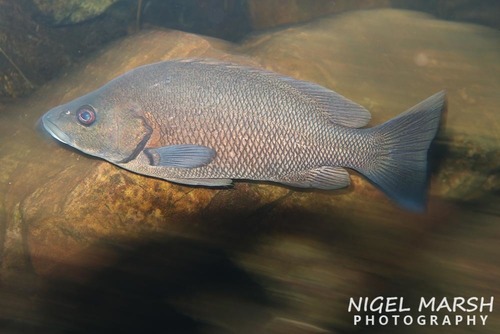
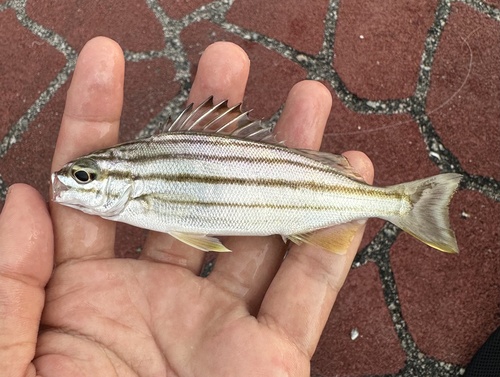
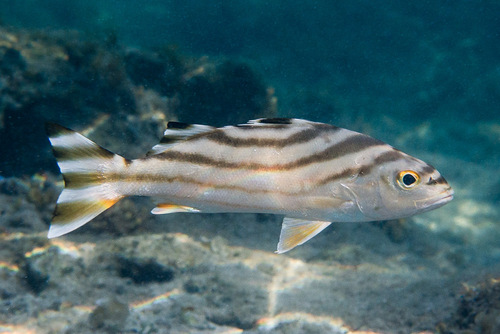
Terapon theraps Cuvier, 1829 is a medium-sized species of grunter with an oblong, moderately laterally compressed body. Its jaws are of equal length, and the mouth and gape are both slightly oblique. In juveniles, the maxilla aligns with the front of the eyes, while it does not reach the eye in adults. Its teeth are conical, arranged in villiform bands, with the outermost row greatly enlarged; there are no teeth on the roof of the mouth. The dorsal fin has 11 or 12 spines and 9 to 11 soft rays; the spiny portion is distinctly arched and marked by a deep notch. The third through sixth dorsal fin spines are the longest, and the notch forms because the second-last spine is around half the length of the last spine. The anal fin has three spines and 7 to 9 soft rays; the third spine is the longest, and it is longer than the longest soft ray. The caudal fin is shallowly forked with rounded lobes. The lateral line holds 46 to 56 pored scales. Adults are mainly dusky-green with green iridescence, fading to silver-white on the belly. They have four broad dark horizontal stripes along the flanks, a large black spot on the dorsal fin, and dusky stripes on the tail. Juveniles are brown with darker stripes, plus white spots arranged in lines in the paler areas between dark stripes, and they have a striped tail. This species reaches a maximum total length of 30 centimetres (12 in). Terapon theraps is widespread across the Indo-Pacific region, where it occurs from the southern Red Sea, along the eastern coast of Africa as far south as Madagascar, and eastwards along southern Asian coasts, including the Seychelles. It extends into the Pacific Ocean as far north as southern Japan, as far south as Australia, and as far east as New Caledonia. It has been recorded twice in the Mediterranean Sea, in 2007 and 2008, and it was likely transported there via ballast water. This species lives in tropical inshore waters of the Indo-Pacific, and is common in brackish waters and among mangroves. Juveniles frequently hide under floating algae and flotsam, especially mats of Sargassum, a behaviour that enables their wide dispersal. It is an omnivorous species, and after spawning, the male parent guards and fans the eggs.