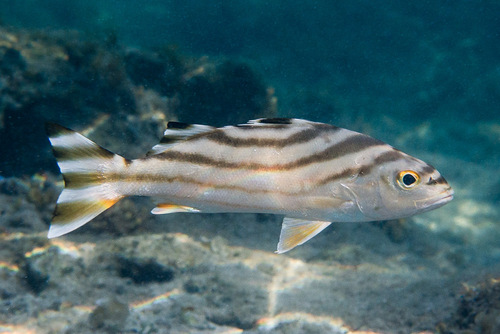
About Terapon jarbua (Forsskål, 1775)
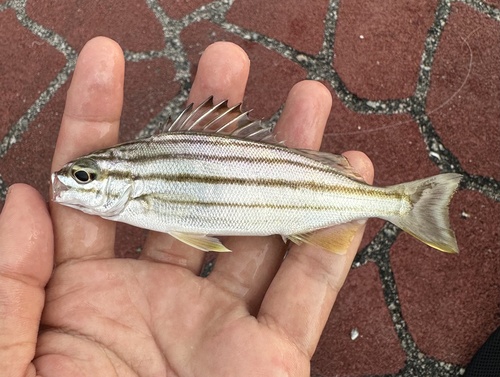
Terapon jarbua is a medium-sized grunter with an oblong, moderately laterally compressed body. It has an oblique mouth, where the jaws are of equal length; in juveniles, the maxilla reaches the level of the front edge of the eye, while in adults it reaches the centre of the eye. Its teeth are conical and slightly recurved, arranged in bands, with the outer row teeth being much enlarged. Juveniles have teeth on the roof of the mouth, but these are absent in many adults. The dorsal fin contains 11 or 12 spines and 9 to 11 rays; the spiny section of the dorsal fin is strongly arched, with the fourth to sixth spines being the longest, and has a deep notch. The anal fin has 3 spines and 7 to 10 soft rays, and the caudal fin is emarginate. The lateral line has 75–100 pored scales. The body is silvery white, marked with 3 or 4 curved stripes that run from the nape to the rear of the body; the lowest stripe continues through the centre of the caudal fin. There is a black blotch on the spiny portion of the dorsal fin between the third and sixth spines, and the tail is striped, with each lobe having a black tip. This species reaches sexual maturity once it attains a total length of 13 centimetres (5.1 in). The most commonly recorded total length is around 25 centimetres (9.8 in), and the longest recorded individual measured 36 centimetres (14 in).
Terapon jarbua has a wide Indo-Pacific distribution. Its range extends from the Red Sea and the coasts of eastern Africa, as far south as South Africa, across the Indian Ocean including the Persian Gulf, and into the Pacific Ocean as far east as Samoa. It extends north to Japan and south to the Arafura Sea and Lord Howe Island. A single specimen was recorded in the eastern Mediterranean Sea in 2010, and it most likely entered the region via the Suez Canal.
This is a euryhaline grunter that can tolerate a wide range of salinities, from pure freshwater up to 70%, allowing it to live in a variety of habitats: fully marine areas, coastal waters, estuaries, coastal lagoons, and freshwater. It is mainly a marine species, but it can move quite far up rivers into fresh water. Juvenile T. jarbua are often abundant in sandy intertidal areas and are frequently found in tidal pools. It is a predatory species that feeds on smaller fishes, and also acts as a cleaner fish by eating ectoparasites from larger fishes; it is known to eat fish scales, which are high in calories. It will also feed on insects and other invertebrates. The distinctive coloration and small scales of T. jarbua may be an adaptation to avoid attack by other members of its own species. Juveniles have been reported to be territorial, and excavate sand craters, which may help them maintain their position as the tide ebbs and flows. Young fish with a standard length between 2 and 5 centimetres (0.79 and 1.97 in) are gregarious, but become territorial once they reach 9 to 15 centimetres (3.5 to 5.9 in) in standard length. T. jarbua can produce sounds for communication using extrinsic muscles attached to its swimbladder, and these sounds change as the fish matures and when the fish's environment changes. Although both juveniles and adults of this species are found in freshwater, reproduction occurs in the marine environment.