About Tephrosia spicata (Walter) Torr. & A.Gray
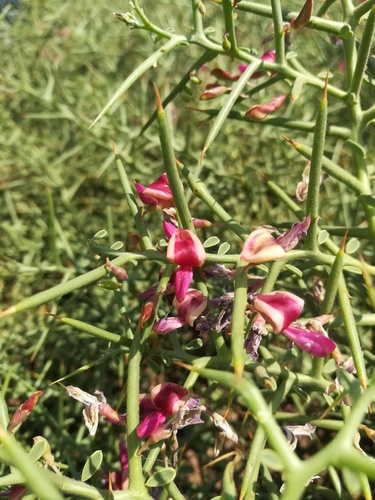
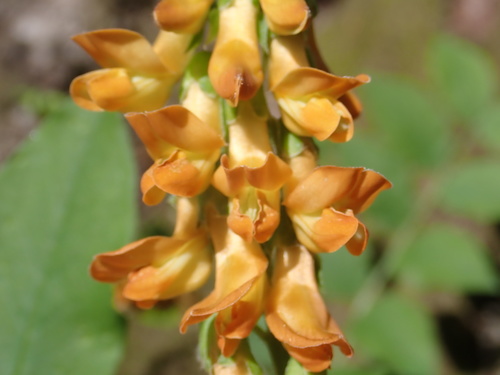
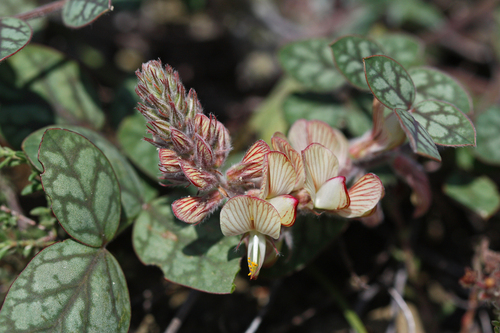
Tephrosia spicata (Walter) Torr. & A.Gray is an herbaceous perennial plant that grows from a cylindrical taproot. It produces odd-pinnate leaves that hold between 7 and 29 leaflets, rarely as few as 1 or as many as 41. The full leaf blade measures 4 to 12 centimeters (1.6 to 4.7 inches) long, and individual leaflets range in shape from oblong-obovate to obovate or elliptic. Leaflet margins are entire; the upper leaflet surface is either glabrous or pubescent, while the lower surface is always pubescent, and often has prominent, parallel secondary veins. Inflorescences grow either opposite the leaves or at the tip of stems, and bloom from May through August. These inflorescences are typically 4 to 60 centimeters (1.6 to 23.6 inches) long, curve upward, start yellowish white, and develop to a pinkish red color. Its legumes are 3 to 5 centimeters (1.2 to 2.0 inches) long and 4 to 6 millimeters (0.16 to 0.24 inches) wide, with sparse to moderate pubescence made up of trichomes longer than 0.6 millimeters (0.024 inches). T. spicata can be distinguished from the related species Tephrosia hispidula by its larger number of flowers and more noticeable gray hairs. Tephrosia spicata is native to the southeastern and mid-Atlantic United States, ranging from southern Delaware south to Florida, and west to Louisiana and Kentucky. It grows in habitats with dry soils, and is most commonly found in pine/scrub oak sandhills, longleaf pine sandhills, and other dry oak or mixed hardwood plant communities. Its occurrence declined after agriculture-related soil disturbance in southwest Georgia. In contrast, its frequency and biomass increased following soil disturbance from clearcutting and chopping in north Florida flatwoods forests. Tephrosia spicata is recognized as an indicator species for the Upper Florida Panhandle Savannas community type, as documented by Carr et al. (2010). It is also known to persist through repeated annual burns.