About Tenodera sinensis Saussure, 1871
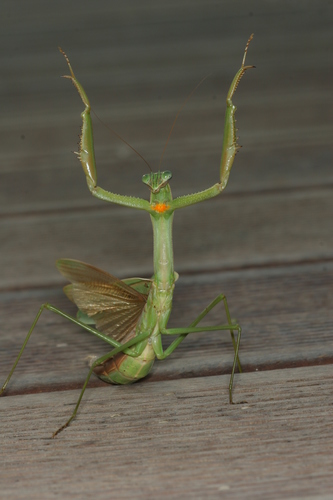
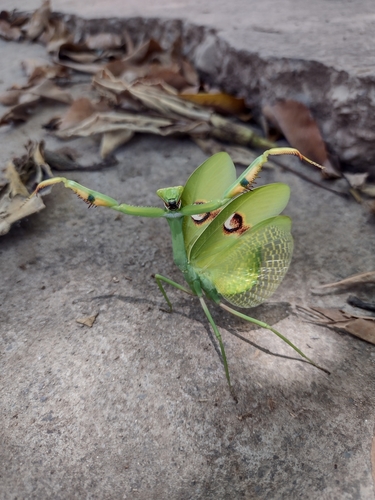
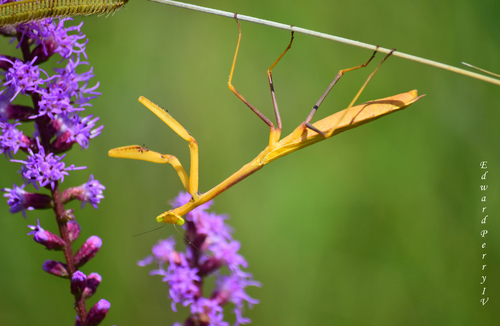
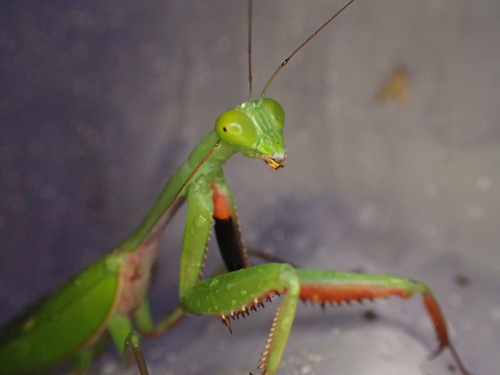
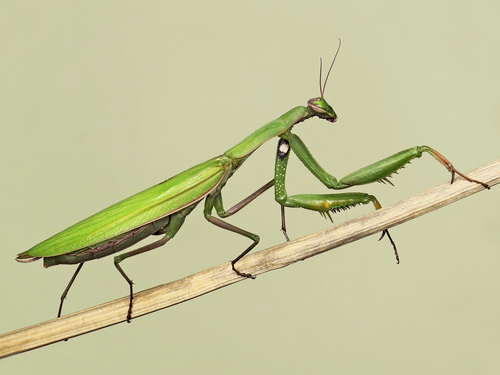
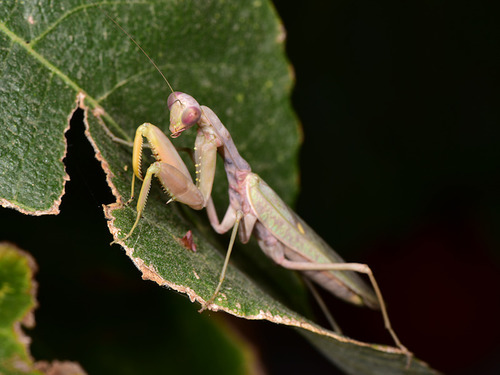
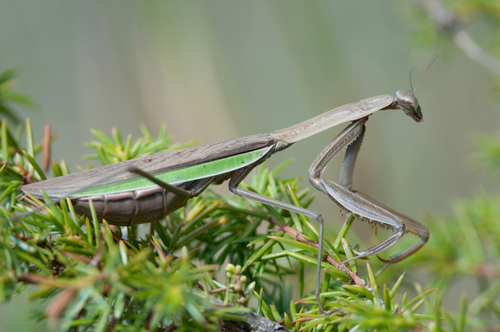
The Chinese mantis, Tenodera sinensis Saussure, 1871, is a long, slender praying mantis that comes in brown and green color forms. It is typically larger than most other praying mantis species, reaching just over 11 cm (4.3 in), and is the largest mantis species found in North America, where it has spread throughout the Northeast United States. Its overall color can range from fully green to brown; brown-form individuals have a green lateral stripe along the borders of their front wings. In low light conditions, this mantis’s eyes appear black, while in daylight they turn clear and match the color of its head. Chinese mantids look very similar to another introduced United States mantis species, the narrow-winged mantid (Tenodera angustipennis). While the two species are similar in appearance, they can be distinguished by the colored spot located between their front legs: the spot is yellow on the Chinese mantis, and orange on the narrow-winged mantid. Adult female Chinese mantises produce multiple semi-spherical egg cases called oothecae, each roughly 2 cm (0.8 in) in diameter and holding up to 300 eggs. These oothecae are most often attached to vegetation, including bushes and small trees. This mantis species is native to China, Japan, the Korean Peninsula, Micronesia, and Thailand. In Japan, T. sinensis is frequently misidentified as Tenodera aridifolia, the Japanese giant mantis; T. sinensis was formerly classified as a subspecies of Tenodera aridifolia.