About Telophorus zeylonus (Linnaeus, 1766)
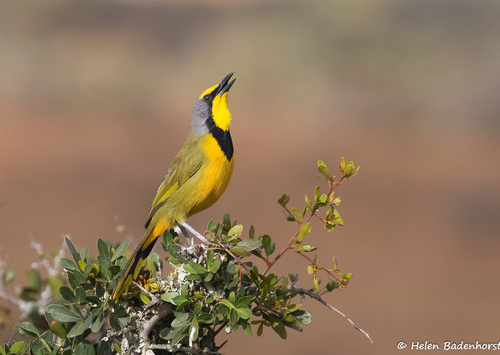
The bokmakierie, with the scientific name Telophorus zeylonus, is a type of bushshrike. The bushshrike family of passerine birds is closely related to true shrikes of the family Laniidae, and was previously classified within Laniidae. This species is endemic to southern Africa, found mainly in South Africa and Namibia, and has one separate isolated population in the mountains of eastern Zimbabwe and western Mozambique. It lives in open habitats, including karoo scrub, fynbos, and urban parks and gardens. It builds a bulky cup-shaped nest in a hedge, scrub, or tree fork. It lays 2 to 6 eggs, most often three, which are greenish-blue marked with red-brown or lilac blotches. Both sexes incubate the eggs, which hatch after around 16 days; the young fledge 18 days after hatching. Adult bokmakieries are 22 to 23 centimeters long. They have olive-green upperparts and a black tail with a noticeable bright yellow tip. Their heads are grey with a yellow supercilium, and their strong bill has a hooked upper mandible. Their underparts are bright yellow with a broad black collar between the throat and breast; this collar extends up the sides of the neck, through the eye, to the bill. Their legs and feet are blue-grey. The two sexes have similar plumage, but juveniles have dull grey-green underparts and lack the black gorget collar. There are four recognized subspecies, which differ primarily in color shade and body size. While the entire bokmakierie species is not considered threatened, the isolated dark subspecies T. z. restrictus, native to the Chimanimani Mountains, has a total population of only around 400 individual birds. The bokmakierie produces a variety of loud whistles and calls, and pairs often call in antiphonal duets. The most characteristic call matches the species' common name: bok-bok-mak-kik. Levaillant named this species bacbakiri, based on the local name that originated from its call, and Dutch settlers gave it the name bokmakierie. Unlike true shrikes, which perch noticeably in open areas, the bokmakierie is shy and tends to hide from view. Like typical shrikes, it feeds on insects, small lizards, snakes, small birds, and frogs. It is hunted and eaten by snakes, mongooses, and large shrikes such as the northern fiscal and southern boubou.