About Telopea oreades F.Muell.
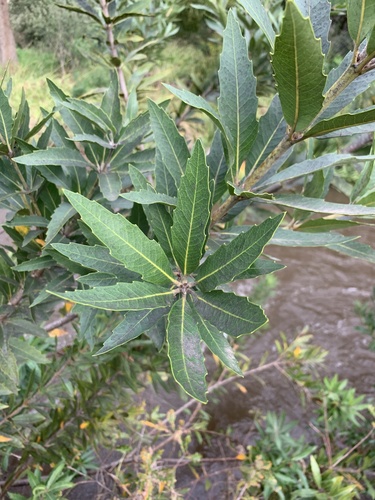
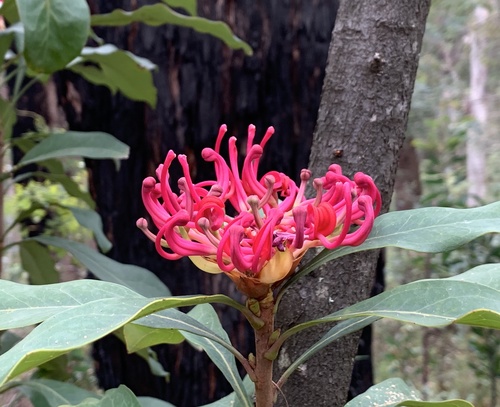
Telopea oreades F.Muell. grows as a large shrub or narrow tree reaching 9–19 m (30–62 ft) high, with a trunk 45 to 60 cm (18 to 24 in) in diameter. The trunk is greyish brown, thin relative to the tree’s height, not buttressed, and has a smooth surface marked with horizontal lenticels and warty protuberances. Smaller branches are brown and smoother, while young plants have a far more erect growth habit than other Telopea genus members, with stems that carry a distinct reddish tinge. Its shiny dark green leaves grow alternately along stems; they are shaped narrow-obovate to spathulate, measuring 11–28 cm (4.3–11 in) long and 1.5–6 cm (0.59–2.36 in) wide. The leaves have a sunken midrib on the upper surface, with a corresponding raised ridge on the underside. Four to six pairs of lateral veins are visible, angled 45 degrees to the midrib; these veins curve and converge to form a clearly visible vein that runs roughly 0.5 cm (0.20 in) inside the leaf margin. The leaf undersurface is paler and greyer, and dried leaves have a granular texture. In its native range, flowering occurs between October and December, with plants growing at higher elevations flowering later than those at lower altitudes. The crimson flowerheads are around 9 cm (3.5 in) in diameter, made up of 36 to 60 individual flowers, with green to pink bracts that can grow up to 3 cm (1.2 in) long. Each flower is enclosed in a 2.5 cm (0.98 in) long perianth, which is much brighter red on the surface facing the flowerhead’s centre than on the outward-facing surface. Flower opening (anthesis) starts with flowers at the centre of the flowerhead, then progresses outwards to the edges or base. Individual flowers bear a sessile anther, which has no filament, and sits next to the stigma at the end of the style. The ovary sits at the base of the style, on top of a stalk called the gynophore; seed pods develop from this structure. A crescent-shaped nectary lies at the base of the gynophore. After flowering, curved leathery to woody follicles develop. These are 5 to 7.5 cm (2.0 to 3.0 in) long, somewhat boat-shaped, and ripen from May to September the following year. They split open to release 10–16 seeds. The flat, brown, winged seeds are arranged in two columns, measuring around 1 cm (0.39 in) long, with a roughly rectangular wing 3.5–4 cm (1.4–1.6 in) long. New shoots often grow directly through existing flowerheads. It can be hard to tell T. oreades apart from T. mongaensis, though T. mongaensis has more prominently veined leaves that are mostly (but not always) narrower than 2 cm (0.79 in) wide. Where both species grow together, T. oreades flowers around one month earlier than T. mongaensis. Telopea oreades grows in moist forests and temperate rainforests of coastal ranges and tableland escarpments, in two separate disjunct areas of southeastern Australia. The southern population is centred on East Gippsland in Victoria, stretching from Orbost to the area around Eden just across the border in far southeastern New South Wales. A separate more northerly population occurs around the Monga Valley near Braidwood, New South Wales, extending to Moss Vale. Unconfirmed reports of the species exist from the area around Brown Mountain and Glenbog State Forest in southern New South Wales, which sits between the two confirmed population areas. In Victoria, plants grow at altitudes ranging from 200 metres (660 ft) in Lind National Park to 1,300 metres (4,300 ft) on Mount Ellery. The species favours wetter eastern and southern slopes, in areas with annual rainfall between 1,000 and 2,000 mm (39 to 79 in). It grows in acidic soil that is high in nutrients and organic matter. In Victoria, associated tree species include shining gum (Eucalyptus nitens), messmate (E. obliqua), mountain grey gum (E. cypellocarpa), cut-tail (E. fastigata), silvertop ash (E. sieberi), southern sassafras (Atherosperma moschatum), black oliveberry (Elaeocarpus holopetalus), blanket leaf (Bedfordia arborescens), Australian blackwood (Acacia melanoxylon), privet mock‐olive (Notelaea ligustrina), banyalla (Pittosporum bicolor), Errinundra plum pine (Podocarpus sp. Goonmirk Rocks), Errinundra pepper (Tasmannia xerophila subsp. robusta) and soft tree fern (Dicksonia antarctica). The prominent position and striking colour of Telopea oreades, like that of many of its relatives in the subtribe Embothriinae across Australia and South America, strongly suggests it is adapted to pollination by birds, and has been for over 60 million years. Bird species recorded visiting its flowers to feed on nectar include red wattlebird (Anthochaera carunculata), eastern spinebill (Acanthorhynchus tenuirostris), crescent honeyeater (Phylidonyris pyrrhopterus), yellow-faced honeyeater (Lichenostomus chrysops), brown-headed honeyeater (Melithreptus brevirostris), white-naped honeyeater (Melithreptus lunatus) and silvereye (Zosterops lateralis). T. oreades has a central taproot and few lateral roots. Like most Proteaceae, it produces fine proteoid roots that grow from larger roots. These roots form dense clusters of short lateral rootlets that create a mat in the soil just below the leaf litter, and are especially efficient at absorbing nutrients from nutrient-poor soils, including the naturally phosphorus-deficient soils common across Australia. The species has a swollen woody base largely located under the soil called a lignotuber, which stores energy and nutrients to support rapid regrowth after bushfire. The wet forests where it grows rarely catch fire; when fire does occur, the plant community becomes an open sclerophyll woodland until slow-growing plants with larger leaves re-establish. After fire, new shoots grow from the lignotuber, which survives even when the above-ground portion of the plant is burned. Seeds also germinate and grow in post-bushfire soil, which has higher nutrient levels and more open conditions with less competition from other plants. Waratah seeds are often eaten and destroyed by animals, and do not travel more than several metres away from the parent plant. To thrive in cultivation, Telopea oreades requires a well-drained location and consistent moisture. Soil with some clay content benefits growth. It is more shade-tolerant than the better-known New South Wales waratah, preferring part-shade but tolerating full sun. It can withstand moderate frosts. Mature plants can be rejuvenated through hard pruning of old stems and branches. Application of low-phosphorus fertilizer in spring and autumn can improve growth. Propagation is done by seed or by cuttings of newly hardened growth. Seed germination rates drop sharply after several months of storage unless the seed is kept refrigerated. Cultivars must be propagated from cuttings to produce daughter plants identical to the parent. T. oreades has been grown successfully in England. It was first cultivated there by Canon Arthur Townsend Boscawen at Ludgvan in Cornwall, from seed he obtained in 1910. He successfully flowered the species by 1915, providing material for an illustration published in Curtis's Botanical Magazine in 1916. By the late 1980s, one plant in Cornwall reached 4.6 metres (15 ft) in height, while another at Wakehurst Place reached 2.5 metres (8.2 ft). Though the species thrives at Wakehurst, it can be very sensitive to typical English soils. The Royal Horticultural Society awarded the species an Award of Merit in 1916. A selected white-flowered form from the Errinundra Plateau, originally known as 'Plateau View Alba' or 'Plateau View White', was registered by the Australian Cultivar Registration Authority in 1990 as 'Errindundra White'. Plantsmen have also developed multiple hybrids between T. oreades and T. speciosissima, aiming to combine T. oreades hardiness with the larger showier flowerheads of T. speciosissima. Cultivars with red, pink, and even white flowers are available. Telopea 'Champagne' is a cultivar registered under plant breeders' rights (PBR) in 2006. It produces creamy yellow flowerheads from October to December, and is a three-way hybrid between T. speciosissima, T. oreades, and the yellow-flowered form of T. truncata. Telopea 'Golden Globe' is a cultivar registered under PBR in 2005. Larger than 'Champagne', it is also a three-way hybrid between T. speciosissima, T. oreades, and the yellow-flowered form of T. truncata. It has been propagated and sold under the name 'Shady Lady Yellow', and was originally bred in the Dandenong Ranges east of Melbourne. Telopea 'Shady Lady Red' is a larger shrub that can reach 5 m (16 ft) high and 2 or 3 m (6.6 or 9.8 ft) wide. A hybrid of T. speciosissima and T. oreades, it arose spontaneously in a Melbourne garden. It was the first cultivar in the 'Shady Lady' series, and became commercially available in the mid-1980s. Its flowerheads are smaller and lack the bracts of its T. speciosissima parent. As its name suggests, it tolerates more shade, it is vigorous and more reliable in temperate and subtropical areas, and grows in semi-shade or full sun. Telopea 'Shady Lady White' is a white-flowered hybrid between T. speciosissima and T. oreades. Telopea 'Shady Lady Pink' comes from a cross between 'Shady Lady Red' and 'Shady Lady White'. Telopea 'Shady Lady Crimson' is a selected colour form developed from 'Shady Lady Red', and became commercially available in Australia in 2010. The timber of T. oreades is fairly hard and resembles silky oak (Grevillea robusta). It is durable, and can be easily polished and worked, making it suitable for use in furniture, picture frames and tool handles.