About Telopea aspera Crisp & P.H.Weston
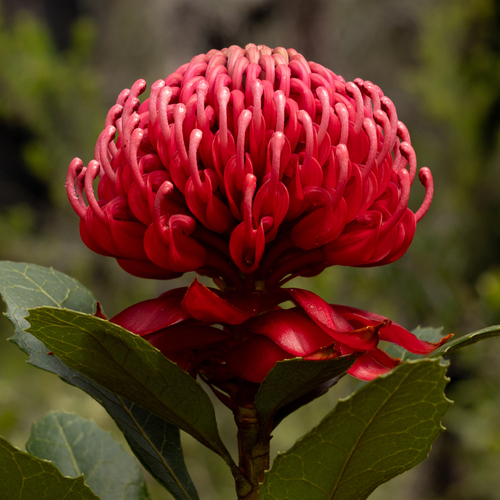
Telopea aspera, also known as Gibraltar Range waratah, is a large erect shrub that grows up to 3 metres (10 ft) tall, and produces one or more stems. It bears alternate dull green leaves that are more coarsely toothed than its southern relative, with 3 to 11 serrations along each leaf margin. The leaves measure 8–28 centimetres (3.1–11.0 in) long and 2–6.5 centimetres (0.8–2.6 in) wide, are tough and leathery, have furry undersurfaces, and show prominent veins on both their upper and lower sides. Its large crimson inflorescences emerge in spring; these inflorescences are large domed flowerheads ringed by bracts, and each flowerhead is made up of 90 to 250 individual flowers. After flowering, the plant produces follicles that are 70–110 mm (2.8–4.3 in) long.
This waratah is endemic to northern New South Wales, Australia, where it is restricted entirely to the Gibraltar Range. It grows in dry sclerophyll forest, and occurs in three distinct plant communities within the Gibraltar Range. The first community, which includes Eucalyptus olida (Gibraltar ash), Eucalyptus ligustrina (privet-leaved stringybark) and Eucalyptus cameronii (diehard stringybark), grows on slopes and crests. The second community, which includes Eucalyptus olida, Eucalyptus pyrocarpa (large-fruited blackbutt) and Eucalyptus planchoniana (needlebark stringybark), grows on ridges and north- and west-facing slopes. Both of these communities are shrubby to open woodland growing on skeletal to shallow granite soil. The third community is a more sheltered association of Eucalyptus campanulata (New England blackbutt) and Eucalyptus cameronii found on lower slopes with sandy or loam soils.
This species was added to Australia's national list of threatened species on 4 September 2024. After bushfire, the Gibraltar Range waratah resprouts from a woody lignotuber, where it stores energy and nutrients to support rapid new growth after fire. Most members of the subtribe Embothriinae, which includes this species, across Australia and South America have prominent, strikingly coloured flower structures, which strongly suggests the group has been adapted to bird pollination for over 60 million years.
Telopea aspera has been rarely cultivated, though some garden specimens previously identified as T. speciosissima may actually be this species. Plants grown at the Australian Botanic Garden Mount Annan have fared poorly and died off during summer, though the cause of this failure is not known. Cultivation at Mount Tomah Botanic Gardens has been more successful. The species' flowers and foliage are considered attractive features for horticulture.