About Telmatobius culeus (Garman, 1876)
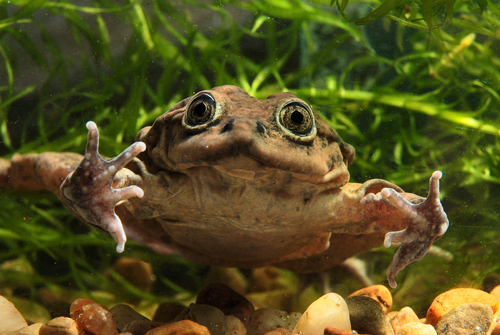
Morphology and color: Along with overall size, different forms of the Titicaca water frog (Telmatobius culeus) differ in the relative size of the dorsal shield — a hard structure on the back — relative head width, and other morphological features, and most bays of Lake Titicaca host their own distinct type. When compared to frogs of similar size, the lungs of the Titicaca water frog are only around one-third the typical size. Instead, the species has extensive, extra skin that helps it breathe in the cold water it inhabits. This baggy skin is especially noticeable in large individuals. In living frogs, the skin folds are swollen with fluid, but if deflated, the frog's actual body is relatively thin. Its coloration is highly variable, but is generally gray, brown, or greenish on the upper body, and paler on the underside. Spots are often present, and these can form a marbled pattern. Individuals living in the coastal southernmost part of Lake Titicaca typically have striped thighs and relatively bright orange underparts. When disturbed, Titicaca water frogs can secrete a sticky whitish fluid from their skin as a defense. Habitat and ecology: Titicaca water frogs live only in lakes and rivers within the Lake Titicaca basin. Adults of the typical form generally live deeper than 10 m (33 ft) in Lake Titicaca itself, though the maximum depth they reach is unknown. While exploring the lake in a mini submarine, Jacques Cousteau filmed individual frogs and their tracks in bottom silt at 120 m (400 ft), which is the deepest recorded depth for any frog species. Other forms of the Titicaca water frog are found at depths no greater than 10 m (33 ft). A study surveying depths from the shore to 7 m (23 ft) near Isla del Sol found that adult frogs were most common at depths between 1.5 and 3 m (5 to 10 ft). Overall, Titicaca water frogs prefer mixed substrates: either muddy or sandy bottoms with some rocks, or areas with abundant aquatic plants and some rocks. Capture for food: This species is eaten as a traditional food, used to make a blended drink called frog juice, and used in traditional medicine where it is claimed to act as an aphrodisiac and treat infertility, tuberculosis, anemia, asthma, osteoporosis, and fever. None of these medicinal claims are supported by evidence. Some local restaurants also sell dishes made with Titicaca water frog as a novelty for tourists. A 100-year-old month-long expedition to Lake Titicaca did not encounter this frog in any regional markets, did not observe any locals hunting it, and when asked, locals said they considered the frog inedible. It is unclear whether this historical report was incomplete, or if a significant change in use has occurred, but by the 2000s, tens of thousands of frogs were caught each year for food and traditional medicine. Even though capture and trade is now illegal, the activity has continued to some extent. Smaller numbers of frogs have been exported to other countries for use as food, for their skin to make frog leather, and for the pet trade.

