About Tellima grandiflora (Pursh) Douglas ex Lindl.
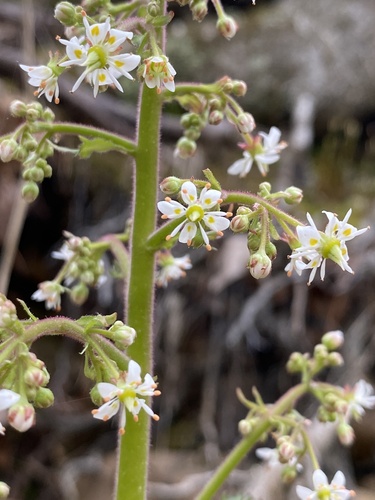
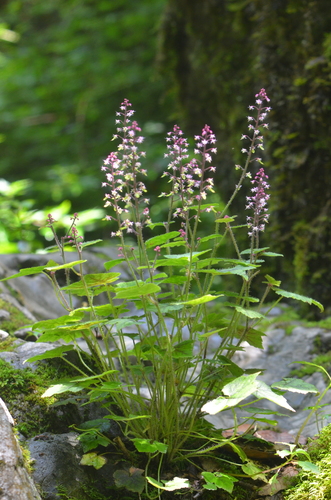
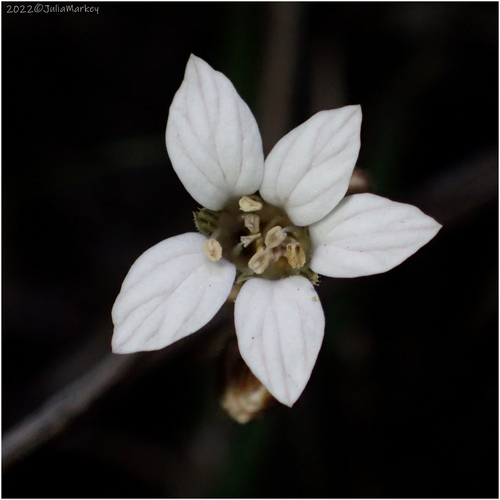
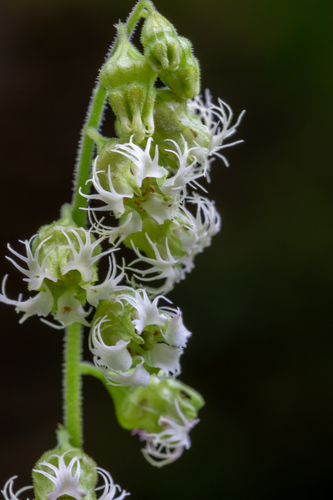
Tellima grandiflora (Pursh) Douglas ex Lindl. produces rounded, stalked leaves that mostly grow from the base, emerging from a rootstock. The leaves are bluntly toothed, and the plant reaches overall heights of up to 30 cm. It remains evergreen during mild winters. Flowers are produced in spring and early summer, borne in terminal raceme spikes that can grow up to 60 cm high. Its green calyx measures 6–8 mm long, and it has five greenish-white to purple flower petals that are pinnately divided, spreading, and deeply fringed. The plant has 10 stamens and 2 styles. This species is native to moist forests in western North America, ranging from Alaska and British Columbia south to northern California. It can escape from cultivation and become naturalized in other regions, such as Ireland and Great Britain. While it is secure across the western parts of its native range, Tellima grandiflora is listed as vulnerable in Idaho and Montana, and critically imperiled in Alberta. Tellima grandiflora is widely grown in gardens, and several different cultivated strains have been developed. It self-seeds freely in suitable climates. The Skagit people used this plant, crushed and prepared as an infusion, to help people recover from sicknesses including loss of appetite. The species contains ellagitannins, chemical compounds that have potential antiviral activity. Tellimagrandin II, an ellagitannin formed from pentagalloyl glucose, is laccase-catalyzed dimerized into cornusiin E within T. grandiflora.