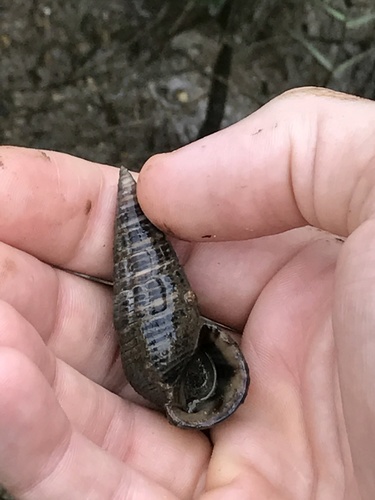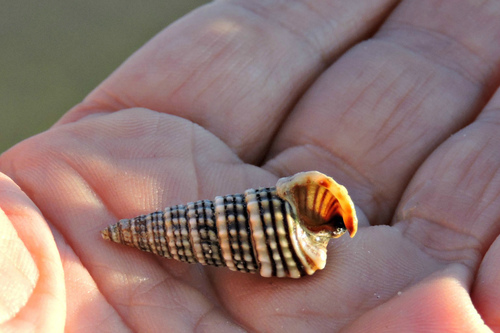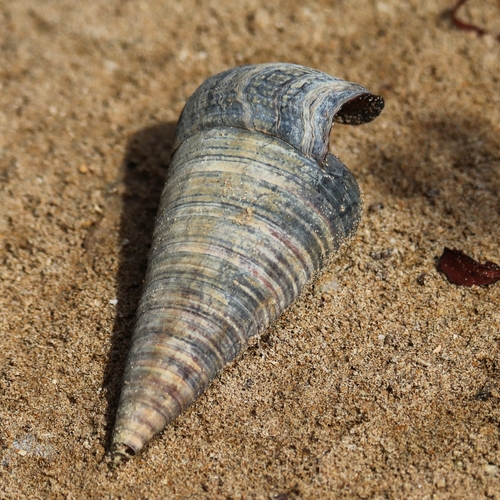
About Telescopium telescopium (Linnaeus, 1758)
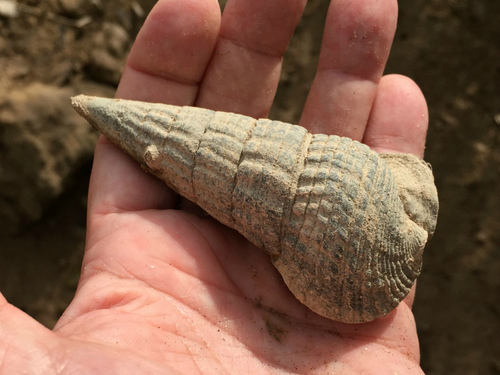
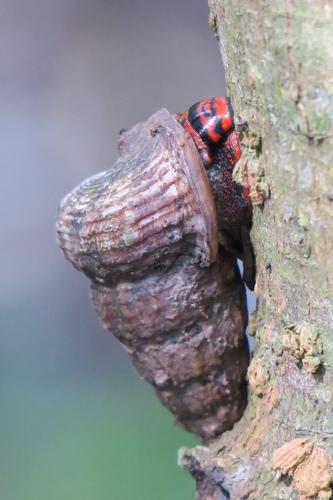
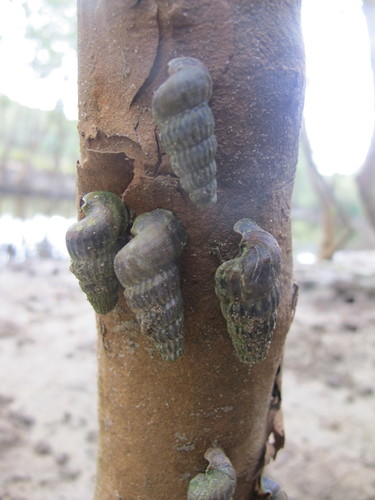
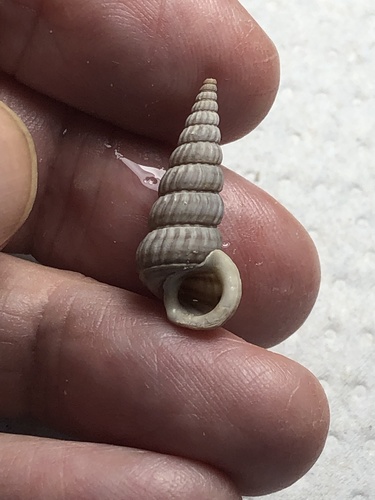
Telescopium telescopium (Linnaeus, 1758) is a gastropod in the Potamidiae family. It is very similar to other Potamidiae gastropods, and differs primarily in being the largest species in the family and having a fold on its columella. Fully grown adults have shells that range from 8–13 cm, making them the largest in the Potamidiae family. The shell is thick and heavy relative to the snail’s body. The shell aperture is perpendicular to the shell’s longitudinal axis, forming a straight-sided cone shape. Unlike most other gastropods, its shell contains 0.12% magnesium carbonate. The operculum is rigiclaudent: the last growth increment always lies tangentially against the labial lip of the previous whorl. This makes T. telescopium an exception within Potamididae, where opercula are typically flexicaudent. The shell is either black or very dark reddish-brown, and it is the only gastropod in the Potamidiae family with a columellar fold. The shell is often covered by barnacles and mud that obscures its natural color. Outside the shell, T. telescopium has a black exterior and a long proboscis, with three eyes: one at the shell boundary and two near the base of the proboscis protrusion. Its respiratory system works like that of other semi-tidal gastropods: it obtains oxygen from water passing over small gills located inside the shell. When the tide recedes, T. telescopium withdraws into its shell to reserve energy and oxygen until the next high tide when it becomes active again. It can store stored oxygen for at least 36 hours and up to 48 hours before dying. Digestion begins at the proboscis, which collects nutrient-rich organic matter that then passes down the esophagus to the stomach. T. telescopium has a large stomach with two associated components before digested material moves into the digestive caecum. The main stomach has a side sac that holds a rod of concentrated digestive enzymes to break down algae and other organic matter. Like all gastropods, T. telescopium moves using a single foot that protrudes from the shell aperture. Movement occurs via a series of muscle contraction waves that extend along the lower surface of the foot, propelling the mollusk forward. The foot excretes a substance called pedal mucus, which has adhesive properties that let T. telescopium move on inverted surfaces, overcoming gravity that would otherwise cause it to fall. Pedal mucus also allows T. telescopium to remain in place during high tide on mangrove foreshores. T. telescopium’s natural habitat is mangrove forests along the Indo-Western Pacific, and the Indian Ocean islands of Madagascar and Réunion. It is concentrated under the muddy surface of mangrove foreshores and on mudflats that are only just covered at high tide, and it occasionally wanders beyond the tide mark range. Global populations of T. telescopium are decreasing due to habitat loss from marine pollution and mangrove deforestation. Its mangrove-associated habitat explains its worldwide distribution. Currently recorded locations include mangrove regions of Goa (India), Chantaburi Province (southeastern Thailand), Panglao (Philippines), Queensland (Australia), Northern Territory (Australia), Western Australia, Singapore, Madagascar, Réunion Island, Cambodia, Indonesia, Iran, Malaysia, Vietnam, and Papua New Guinea. T. telescopium is a detritivore. It primarily obtains nutrients on mangrove forest floors, feeding on rich decomposed organic matter left behind during ebb tide and surface algae. It only scavenges for food when it is fully or partially covered, with just its shell tip exposed, as a protection against heat, desiccation, and predators. It feeds on mangrove sediment and mangrove leaves to obtain important bacteria it needs to function, including Bacillus cereus, Pseudomonas aeruginosa, Bacillus sphaericcus, and Staphylococcus aureus. T. telescopium is not a threat to humans. In addition to deforestation and marine pollution, microplastics have become a major threat to T. telescopium. A study examining microplastic effects found a correlation between an increase in mass and the level of ingested microplastics in the digestive organ and inhaled microplastics in the respiratory system. The most common type of microplastic found was film, followed by fibre, then fragment. T. telescopium is used as a biomonitor for copper (Cu), zinc (Zn), and lead (Pb) in tropical intertidal regions. Soft tissue and shell components accumulate trace metals over the organism’s lifetime, and these accumulated concentrations are used for biomonitoring. The most commonly used components are the digestive caecum and the shell: the shell is used as a Pb biomonitor because it accumulates more lead than any soft tissue, while the digestive caecum is used as a Zn biomonitor because it accumulates more zinc than any other component. Other soft tissues that can be used as biomonitors for Cu, Zn, and Pb include the foot, cephalic tentacle, mantle, muscle, and gills. In 2013, T. telescopium was used as a biomonitor in Darwin to detect levels of nitrogen and carbon stable isotopes in the city’s sewage. The trial was successful, showing a strong correlation between nitrogen and carbon isotopes in T. telescopium tissue and sediment samples from its habitat. In 2010, it was used as a biomonitor for iron (Fe), magnesium (Mg), Zn, and Cu in the Veller Estuary region of southeast India; heavy metal readings from T. telescopium tissue and shell matched sediment recordings, leading to the development of new pollution reduction methods for the region. T. telescopium is a traditional food in parts of Southeast Asia, particularly Singapore. It is steamed before consumption and often served with chilli. It is the only known Potamidiae species eaten by Aboriginal peoples, among whom it is considered a delicacy due to its rarity. It is prepared by light roasting, steaming, or boiling before consumption. In coastal regions of Australia’s Northern Territory, it was often called “poor man’s tucker”, because many other more prized shellfish were widely available there. When eaten, T. telescopium has low protein content and a peppery taste. In all regions, the shell’s spire is broken before cooking to prevent explosion from pressure build-up. After cooking, the internal tissue falls away from the shell, or a stick can be used to remove tissue that sticks to the shell interior. T. telescopium is sometimes used as fishing bait, and its shells can be used to make lime. Studies suggest that ingested T. telescopium tissue may act as a central nervous system depressant. This research is still under investigation, as tests have not yet passed in vivo trials in rodents; however, all rodents that consumed T. telescopium tissue showed symptoms associated with central nervous system depressants. Preliminary studies have examined Ammonium Sulfate protein (SF-50), a protein excreted from the spermatheca gland of T. telescopium. Only in vitro tests have been conducted so far, but SF-50 has shown agglutinating and spermicidal effects on microbes and human sperm cells, meaning the substance could potentially be used as an antimicrobial rub or spermicide in the future. T. telescopium is also used in the synthesis of some asthma medications. Trials have tested crushed T. telescopium shell powder as an adsorbent to remove copper ions from synthetic wastewater, and found the powder is effective, and could be a low-cost substitute for other adsorbents.