About Telegonus cellus
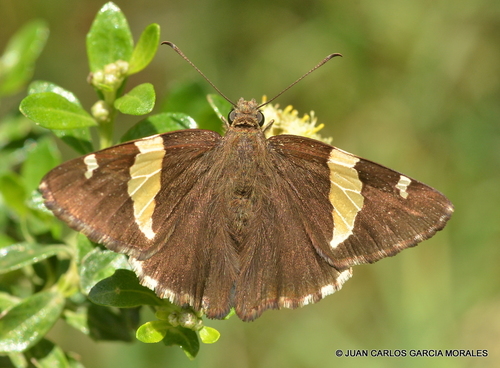
Telegonus cellus, commonly known as the golden banded-skipper, has distinct wing characteristics: the upperside of its wings is chocolate brown, with a golden median band on the forewing, and a checkered fringe on the hindwing. The underside of the wings is very similar in appearance to the upperside. Its wingspan ranges from 32 to 44 millimetres, or 1.25 to 1.75 inches. For habitat, this species prefers moist, steep woodlands in eastern regions, while in the southwest it favors canyon riparian habitat. It appears to be declining in the eastern portion of its range, where it has lost habitat around Washington, D.C., and around West Virginia. In its life cycle, golden banded-skippers use an unusual combination of patrolling and perching during courtship. Females lay eggs in rows of two to nine on the underside of host plant leaves. Eggs are yellow, and turn tan just before hatching. The larva constructs a leaf nest by attaching leaves together with silk, and leaves the nest to feed at night. The larva is pine green with small yellow spots and a yellow lateral stripe; its black head has two orange facial spots, and it has a reddish collar. The pupa is dark brown with a greenish tint, and the species overwinters in the pupal stage. The golden banded-skipper has one to three broods per year.